kaishun team | Kaishun Engineering Machinery Product Specialist | Published July 29, 2026
A self-loading concrete mixer loads raw materials, mixes, transports, and discharges concrete without a separate batching plant or mixer truck. Capacities on the market run from roughly 0.32m³ to 6.5m³, and the right size depends on daily pour volume, site access, and terrain — not on price alone.
What a Self-Loading Mixer Actually Replaces
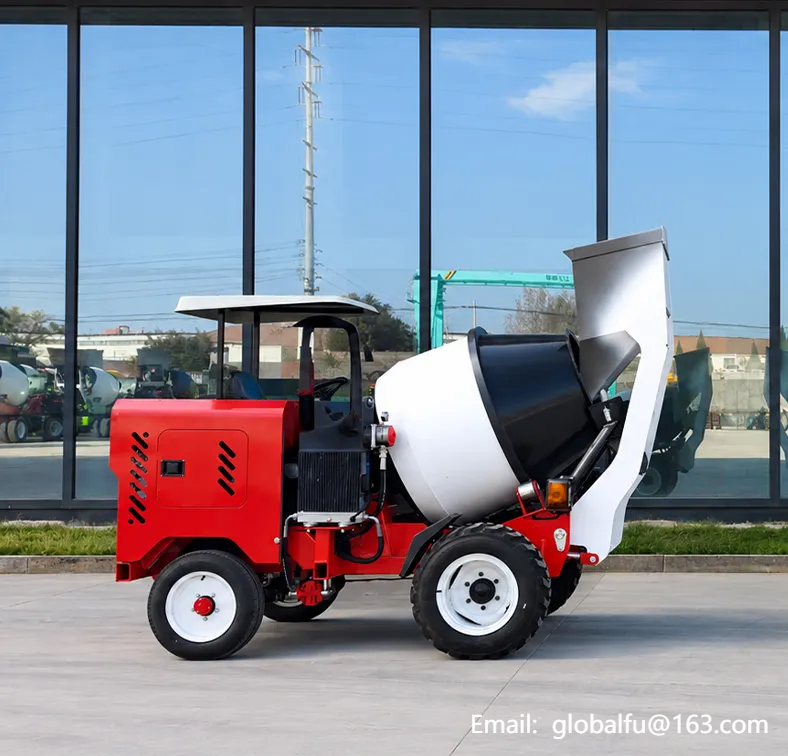
On a conventional site, concrete moves through three separate stages: a batching plant mixes it, a transit mixer truck carries it, and a pump or chute places it. A self-loading mixer folds the first two stages into one chassis. It has a bucket that scoops aggregate and cement directly from stockpiles, a water tank, a rotating drum for mixing, and a discharge chute — all on one machine, often with hydrostatic drive so a single operator runs the whole cycle.
That consolidation matters most where a fixed batching plant isn’t practical: rural roadwork, scattered rural housing projects, remote mining access roads, or any site where trucking in ready-mix concrete adds hours and cost per load.
Self-Loading vs. Transit Mixer: Where the Real Differences Show Up
The comparison most buyers actually need isn’t abstract. It comes down to who does the batching, how far material has to travel, and how many people it takes to run the operation.
| Dimension |
Self-Loading Mixer |
Transit Mixer + Batching Plant |
| Batching location |
On the machine, at point of use |
Centralized plant, then hauled |
| Crew needed |
Typically 1 operator |
Plant crew + truck driver(s) |
| Setup for a new site |
Minimal — drive in, load, mix |
Requires plant proximity or long haul |
| Best fit for volume |
Intermittent to mid-volume pours |
Continuous high-volume pours |
| Terrain flexibility |
Wheeled or crawler undercarriage available |
Limited by truck access roads |
| Material control |
Batch-by-batch on demand |
Batched in advance, can set before placement |
Compared with the rental-fleet approach many general contractors default to — bringing in a transit mixer and a separate loader for every pour — a self-loading unit shifts the work from coordinating multiple trucks to running one machine on a schedule the site controls.
| Model |
Output Capacity |
Engine |
Undercarriage |
| 0.32CBM Crawler |
0.32m³ |
RATO R740-1 |
Crawler track |
| 0.5CBM |
0.5m³ |
Diesel |
Wheeled |
| 0.8CBM |
0.8m³ |
Diesel |
Wheeled |
| 1.2CBM |
1.2m³ |
Diesel |
Wheeled |
| 1.8CBM |
1.8m³ |
Diesel |
Wheeled |
| 2CBM |
2.0m³ |
Diesel |
Wheeled |
| 3.5CBM |
3.5m³ |
Diesel |
Wheeled |
| 3.8CBM |
3.8m³ |
Diesel |
Wheeled |
| 4.0CBM |
4.0m³ |
Diesel |
Wheeled |
| 5.5CBM |
5.5m³ |
Diesel |
Wheeled |
| 6.5CBM |
6.5m³ |
Diesel |
Wheeled |
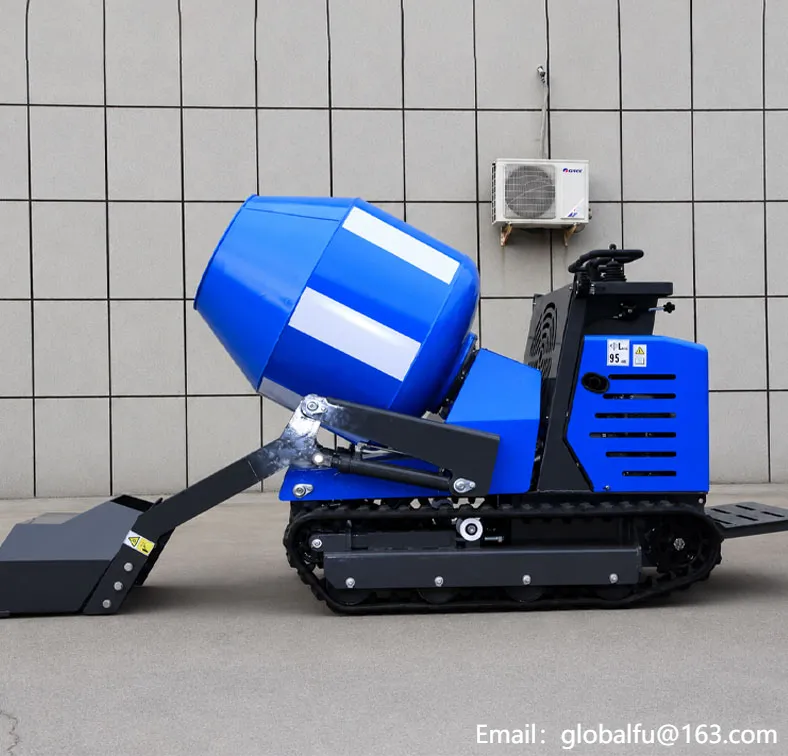
The 0.32CBM crawler model is the outlier in this table, and it’s an outlier for a reason: it’s the only model built on tracks rather than wheels, which is what lets it work slopes and soft ground the wheeled units can’t reach. Beyond the RATO R740-1 engine on that crawler model, published specs for the wheeled range list “diesel engine” without a specific make or displacement — worth confirming directly with the factory before it goes into a quote or spec sheet.
How to Match Capacity to Your Jobsite
Capacity selection isn’t a straight line from project size to model number. Work through it in this order:
- Calculate daily pour volume, not total project volume — a 3.5CBM unit doing four cycles an hour outperforms a 6.5CBM unit sitting idle between pours.
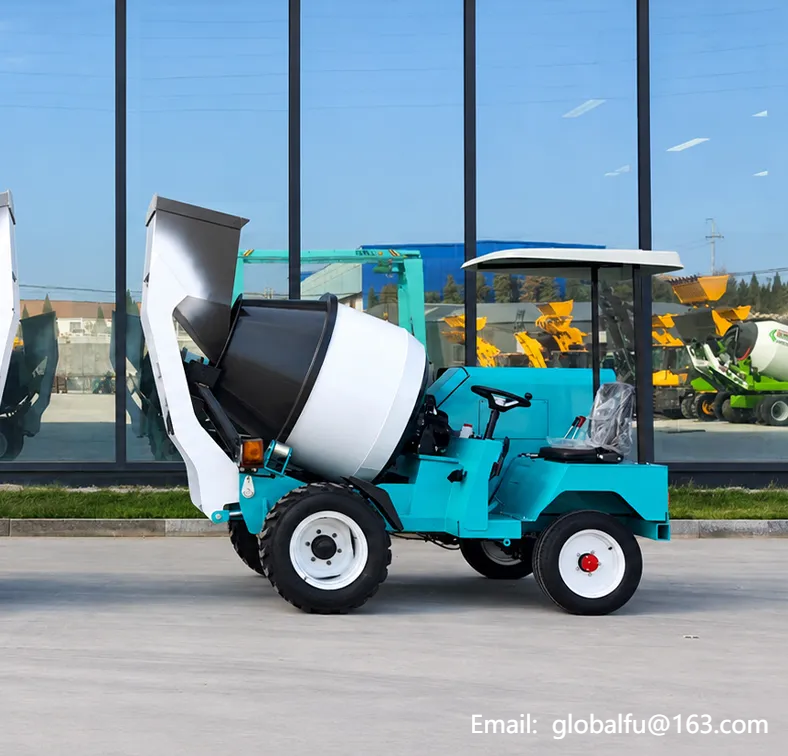
- Check site access width and slope. If access roads are under 3 meters wide or grades exceed what a wheeled loader handles, the crawler-based 0.32CBM model is the only option in this range that fits.
- Count available operators. One self-loading unit needs one operator; running two smaller units in parallel needs two.
- Confirm aggregate stockpile layout — the bucket needs a clear approach path to load without repositioning constantly.
- Cross-check against future project pipeline. A mid-range 2–4CBM model that covers this project and the next one is often a better capital decision than the exact-fit unit for a single job.
Where Buyers Get This Wrong
The most common misconception is treating a self-loading mixer as a universal replacement for a stationary batching plant, regardless of scale. It isn’t. Past a certain continuous daily volume — large commercial pours or multi-story structural work — a fixed plant with dedicated transit trucks still moves more concrete per hour because the mixing and hauling happen in parallel instead of in sequence on one machine.
The second mistake is picking undercarriage type by price instead of terrain. A wheeled model costs less and moves faster on compacted ground, but it will bog down on the same muddy or sloped access road a crawler unit handles without issue. Matching undercarriage to terrain matters more than the capacity number for sites without established roads.
Is a Self-Loading Mixer Actually Cheaper Than the Alternatives?
There’s no fixed number to give here, and any article that gives you one is guessing. Pricing on this equipment is quoted according to model, configuration, engine option, quantity, and destination — engine brand and shipping distance alone can shift the landed cost significantly. The realistic path is to contact the manufacturer for a customized quotation once model, engine option, and destination are settled, rather than budgeting off a number found online.
What is fixed regardless of price is the trade-off: buying shifts cost from recurring rental and haulage fees to upfront capital and ongoing maintenance. Whether that trade favors you depends on how many pour-days you’ll actually run the machine over its service life, not on the sticker price alone.
Quality Standards and What’s Still Unverified
Kaishun’s equipment is produced under an ISO 9001 quality management system and carries CE certification for the categories the company states are covered, alongside more than 100 invention and utility model patents across its product range. Those are meaningful baseline standards for construction machinery entering export markets, but they’re company-level claims — certificate numbers, issuing bodies, and validity dates for the specific self-loading mixer models aren’t published on the reviewed pages. Anyone specifying this equipment for a tender or a compliance-sensitive project should request the actual certificate documents before relying on the general claim.
With more than 20 years in construction machinery manufacturing and export, the company’s self-loading mixer range sits within a broader catalog that also includes wheel loaders and lowbed trailers — relevant if a project needs the mixer delivered alongside loading or transport equipment rather than sourced separately.

FAQ
Q: Can a self-loading concrete mixer produce concrete that meets structural-grade specifications, or is it only for basic pours?
A: The mixer itself is a batching-and-mixing tool — the concrete grade it produces depends on the mix design and materials loaded into it, the same as any batching method. It’s not inherently limited to non-structural work, but quality control (aggregate consistency, water ratio accuracy) rests more on operator discipline since there’s no separate plant QA step.
Q: Does a self-loading mixer need a dedicated concrete pump to place the mix?
A: No — most models discharge directly via a chute into forms, footings, or a wheelbarrow relay. A pump becomes relevant only for pours that need vertical lift or long horizontal reach beyond the chute’s range.
Q: What’s the practical difference between the 0.32CBM crawler and the 0.5CBM wheeled model?
A: Beyond the capacity gap, the deciding factor is ground condition. The crawler model trades speed and capacity for the ability to work slopes, mud, and unformed access roads that would stall a wheeled unit.
Q: How long does a full load-mix-discharge cycle typically take?
A: Cycle time isn’t published as a fixed spec in the reviewed model pages and varies by capacity, aggregate loading speed, and mix design — confirm this figure directly with the manufacturer for the specific model under consideration.











 July 29, 2026