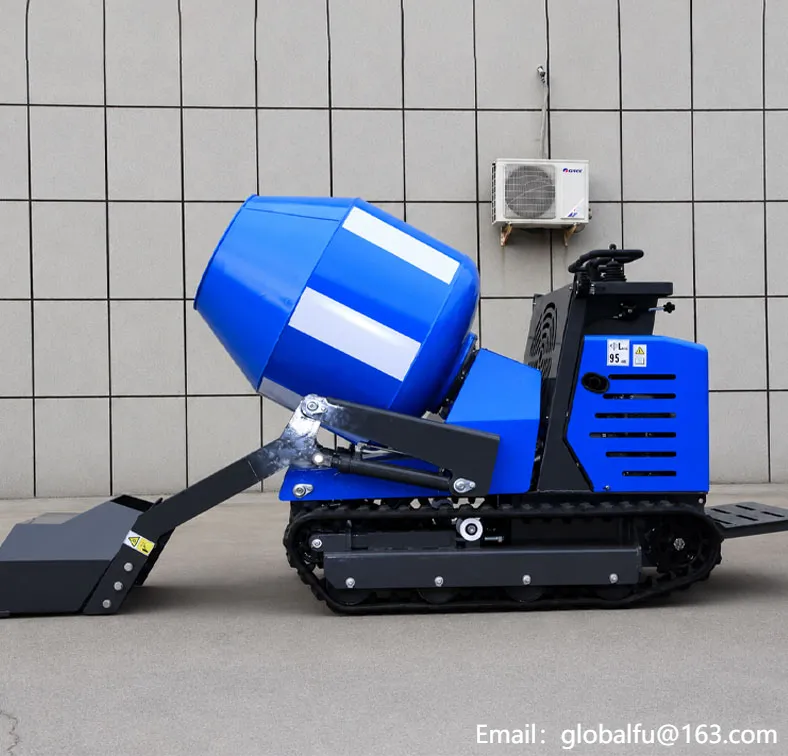
A small concrete mixer is usually understood as a portable drum unit fed by hand. Kaishun does not list that type in its published concrete mixer range. Its smallest option is the 0.32CBM Crawler Self-Loading Concrete Mixer, which combines loading, mixing, transporting, and discharging in one machine.
For rural and residential construction, this combination changes how concrete reaches the work area. Instead of treating mixing and transport as separate tasks, buyers can evaluate one machine for both. However, a small output capacity does not automatically mean the machine will fit through a narrow entrance or operate within a restricted work area.
The first step is therefore to compare the machine with the actual site: its access route, material storage area, daily concrete demand, and discharge location.
What “Small Concrete Mixer” Actually Covers
Searches for “small concrete mixer,” “mini concrete mixer,” and “small cement mixer” commonly describe a portable drum mixer on wheels or a stand. A worker loads aggregate, sand, cement, and water into the drum, then moves the mixed concrete to the pour using wheelbarrows or other handling methods.
Cement is only one ingredient in the mixture. The finished material is concrete, which is why equipment specifications generally use the term concrete mixer.
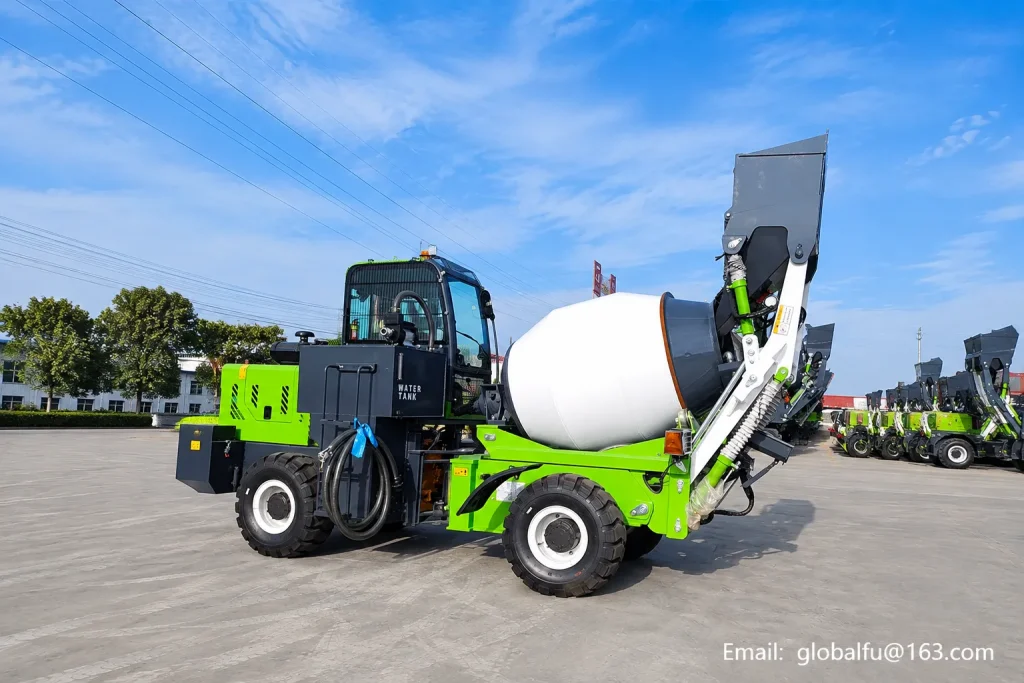
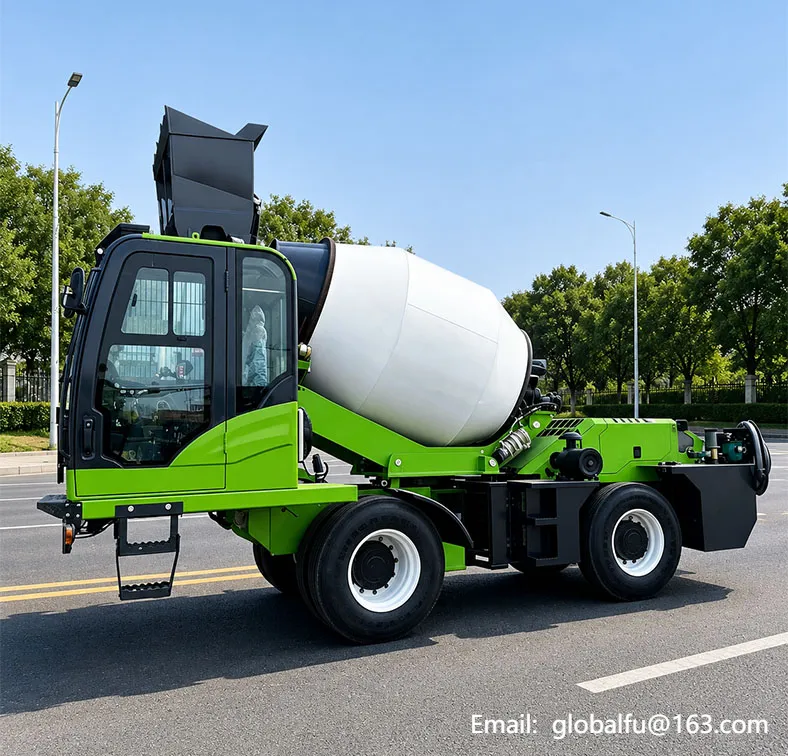
A second category is the self-loading concrete mixer. This is a vehicle that loads materials, mixes them on board, and travels to the discharge point. It belongs to a different equipment class, with a different purchase decision, operating process, and maintenance requirement.
The useful comparison is therefore broader than drum size alone. Buyers should consider how materials are loaded, how concrete is transported, and how the equipment will move around the site.
Where Kaishun Fits, and Where It Does Not
Kaishun’s published concrete mixer catalog consists of self-loading models with output capacities from 0.32m³ to 6.5m³. It does not list portable, hand-fed drum mixers.
If your requirement is an occasional batch using a few bags of material, this range may be more equipment than the job needs. A self-loading mixer should be assessed as a mobile concrete production and handling machine, rather than as a direct substitute for a basic portable drum.
For buyers who need repeated batches and on-site concrete transport over rural or uneven ground, the 0.32CBM crawler model is the entry point in Kaishun’s range.
Kaishun is a China-based manufacturer with more than 20 years of export experience. The 0.32CBM crawler is the smallest of the eleven self-loading sizes described in its range.
Start With the Site Workflow
Before selecting a capacity, map the route from raw materials to the final pour.
Identify where aggregate, sand, cement, and water will be available, where the machine will load, and how it will reach the discharge point. A compact mixer may suit the required batch volume while still facing restrictions elsewhere in this route.
This planning also helps explain your requirements to the factory. A site sketch showing entrances, narrow sections, loading areas, and pour locations is more useful than asking only for the smallest available model.
0.32CBM Crawler Self-Loading Concrete Mixer: Published Specifications
| Item |
Published Information |
| Type |
Crawler self-loading concrete mixer |
| Output capacity |
0.32m³ |
| Engine |
RATO R740-1 |
| Functions |
Loading, mixing, transporting, and discharging in one machine |
| Listed applications |
Rural construction, residential construction, road and bridge engineering, mining and tunneling, municipal and urban infrastructure |
Overall dimensions, track width, weight, engine power, fuel type, discharge height, and gradeability are not included in the published data referenced here.
Treat the table above as the complete confirmed specification list until the factory supplies a model-specific datasheet. The listed application categories do not, by themselves, establish suitability for a particular slope, tunnel, entrance, or ground condition.
What These Specifications Tell You
The published information identifies the machine type, rated output, engine model, and combined operating functions. It provides a starting point for deciding whether a crawler self-loader belongs on your shortlist.
It does not provide enough information to confirm transport arrangements, passage through restricted entrances, operation on slopes, or compatibility with a particular discharge point. Those decisions require additional measurements and factory confirmation.
Drum Mixer vs. Crawler Self-Loader
The main difference is how mixing connects with loading and concrete transport.
| Dimension |
Portable Drum Mixer — General Category |
0.32CBM Crawler Self-Loader |
| Loading materials |
By hand or with a small loader |
On-board loading function |
| Moving mixed concrete |
Wheelbarrow or other handling method |
Machine transports the mixed concrete |
| Ground travel |
Towed or carried, depending on the unit |
Crawler undercarriage |
| Power source |
Varies by unit |
RATO R740-1 engine |
| Best-fit work pattern |
Occasional small batches |
Repeated batches over uneven ground |
A portable drum mixer can be assessed mainly around its mixing task. A crawler self-loader also needs to be assessed around its travel route, loading process, and discharge arrangement.
The engine-powered crawler also introduces fuel planning and engine upkeep. These requirements should be considered alongside the potential reduction in separate loading and transport tasks.
Neither category is automatically the better purchase. The appropriate choice depends on the amount of concrete required and the work needed to move it into position.
A Common Mistake: Buying by the Word “Small”
“Small” describes relative batch capacity. It does not establish site clearance.
A 0.32m³ machine is small compared with a 6.5m³ model, but no overall width is published for this crawler in the data referenced here. Buyers should not assume it will pass through a garden gate, narrow lane, doorway, or restricted entrance.
Access planning should also cover more than the narrowest straight section. Ask the factory what space is needed for turning, loading, and positioning for discharge. A machine that passes through an entrance may still lack sufficient operating space beyond it.
Output Capacity and Drum Volume Are Different
Another purchasing risk is comparing capacity figures that describe different things.
Some manufacturers publish drum volume, while others publish finished concrete output. Kaishun lists 0.32m³ as output capacity for this model.
When comparing quotations, ask each supplier to identify what its capacity figure represents. A larger numerical value is not a useful advantage if it measures a different volume.
Five Checks Before You Order
1. Measure the Complete Access Route
Measure the narrowest point between the unloading area and the pour location. Include gates, lanes, doorways, ramps, and any other restrictions.
Record measurements in millimeters and send them with your inquiry. The factory’s confirmed machine width must allow clearance on both sides.
Also provide photographs or a simple route drawing where turning areas, overhead restrictions, or changes in ground level could affect access. Ask for confirmation against the machine’s complete operating dimensions.
2. Calculate the Number of Batches Required
Divide your daily concrete requirement by 0.32m³ to estimate the number of batches at rated output.
For example:
3m³ ÷ 0.32m³ = 9.375 batches
This means approximately 10 batches are needed for a 3m³ pour.
That calculation estimates batch quantity, not completion time. A working cycle includes loading, adding materials and water, mixing, travelling, positioning, discharging, and returning.
No confirmed cycle time is provided here, so a daily production figure should not be calculated from capacity alone. Ask the factory to explain the expected workflow for a site similar to yours.
If the batch count appears too high for the available working period, compare the 0.5CBM or 0.8CBM models in the same range. Their access requirements must be checked separately.
3. Confirm the Engine Configuration
The published engine model is RATO R740-1.
Request its power, fuel type, and maintenance requirements for the quoted configuration. Confirm that the required fuel and routine service items are available locally.
The engine model name alone should not be used to assume specifications that are absent from the published product data.
4. Request the Relevant Certificate Documents
Kaishun’s website states ISO9001 quality management and CE certification. Certificate numbers, issuing bodies, and model-specific coverage are not included in the information referenced here.
Ask for the documents applicable to the machine being quoted and check that the model identification matches the order.
Confirm destination-market requirements separately. Website certification statements should not replace a review of the actual documents supplied for your purchase.
5. Confirm Spare Parts and Service Arrangements
Before placing the order, ask how technical support and replacement parts will be provided in your country.
Clarify the process for identifying parts, submitting a service request, and obtaining maintenance guidance. Request the available operating and maintenance documentation for the quoted configuration.
These details help you plan ownership beyond delivery and avoid relying on assumptions about local support.
FAQ
Does Kaishun sell a hand-fed mini concrete mixer?
Its published concrete mixer range lists self-loading models, starting at 0.32CBM. It does not list a hand-fed portable drum mixer.
What is the output capacity of the smallest Kaishun mixer?
The 0.32CBM Crawler Self-Loading Concrete Mixer has a published output capacity of 0.32m³.
What engine does the 0.32CBM crawler model use?
The category page lists a RATO R740-1 engine. Power and fuel details should be requested from the factory.
Will it fit through a narrow entrance?
This cannot be confirmed from output capacity. Request the overall dimensions and compare them with the complete access route, allowing operating clearance.
How many batches are needed for 3m³ of concrete?
Approximately 10 batches at the published 0.32m³ output capacity. This does not establish the time required to complete the pour.











 October 17, 2026