Kaishun Engineering Team | Technical Content, Qingdao Kaishun Imp & Exp Co., Ltd. | Published: 19 August 2026
Specifications in this article reflect the Kaishun catalog as of August 2026. Model parameters are subject to change; confirm the current configuration sheet at the quotation stage.
A self-loading concrete mixer loads, weighs, mixes and discharges from one machine, so one operator replaces a loader, a mixer and a haul unit. Capacity in the Kaishun catalog runs from 0.32 to 4.0 CBM per batch. The right size is set by achievable daily output, not by drum volume alone.
That last sentence is where most first-time buyers go wrong, so the sizing method comes first and the parameter tables come after it.
Why drum capacity is the wrong number to shop on
A 4.0 CBM machine does not produce four times what a 1.0 CBM machine produces. Drum volume only sets the size of one batch. Daily output is set by how many complete cycles the machine finishes in a shift, and a cycle includes things that have nothing to do with the drum:
- Travelling to the aggregate stockpile
- Self-loading the bucket, sometimes in two or three passes for the larger sizes
- Weighing and adding water and cement
- Mixing to a consistent batch
- Travelling to the pour point
- Discharging and repositioning
On an open site with the stockpile 30 metres from the pour, steps 1 and 5 are nearly free and batch size dominates. On a constrained site — a hillside road widening, a factory extension with one gate, a bridge abutment reached by a single haul track — travel and repositioning dominate, and a bigger drum can lower daily output because the machine spends its shift manoeuvring instead of mixing.
The arithmetic is simple enough to do before you request a quotation:
Daily output = batch size (CBM) x 60 / cycle time (minutes) x productive hours
Time one full cycle on your own site with whatever machine you have now, or walk the route and estimate it honestly. Two worked cases, using assumed cycle times rather than any measured Kaishun figure:
| Site condition |
Batch size |
Assumed cycle |
Cycles / 7 productive hours |
Daily output |
| Open site, stockpile beside the pour |
1.8 CBM |
12 min |
35 |
63 CBM |
| Open site, stockpile beside the pour |
3.8 CBM |
18 min |
23 |
87 CBM |
| Constrained access, 400 m haul, one turning area |
1.8 CBM |
22 min |
19 |
34 CBM |
| Constrained access, 400 m haul, one turning area |
3.8 CBM |
34 min |
12 |
46 CBM |
The cycle times above are illustrative placeholders for your own timing, not published machine data. Run the same table with your numbers. The point is the shape of the result: doubling batch size did not double output in either column, and the gap narrows sharply once access gets tight.
Two more limits sit outside the machine entirely. Cement and aggregate delivery to a remote site often caps daily production well below what the mixer could physically produce, and a pour that must be placed and finished by a small crew has its own ceiling. Size the mixer to the tightest of the three constraints, not to the largest number on the brochure.
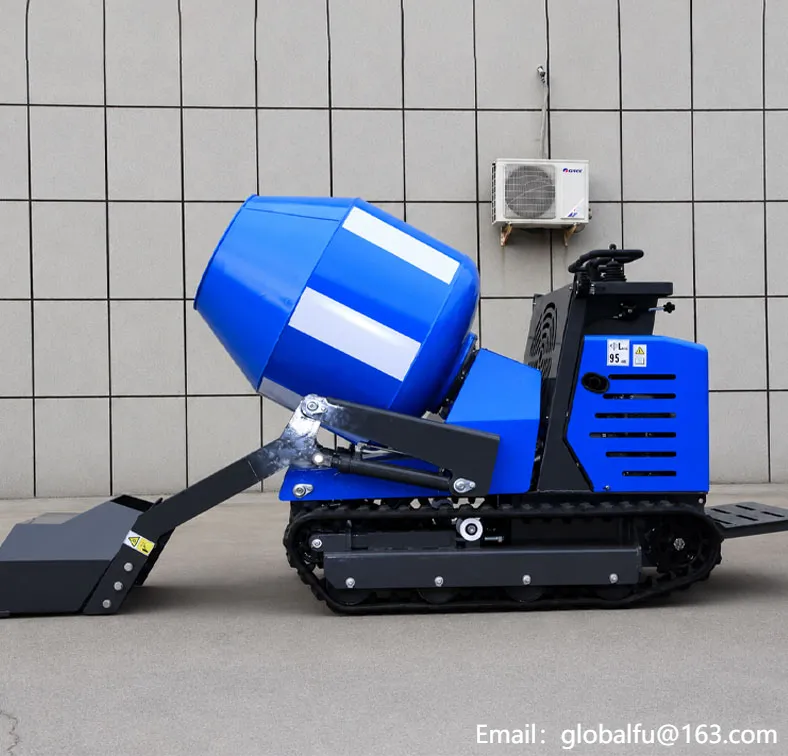
Catalog parameters: what is confirmed and what is quoted
Output capacity across the Kaishun range: 0.32 / 0.5 / 0.8 / 1.2 / 1.8 / 2 / 3.5 / 3.8 / 4.0 CBM.
| Parameter |
Catalog position |
| Output capacity |
0.32, 0.5, 0.8, 1.2, 1.8, 2, 3.5, 3.8, 4.0 CBM |
| Drive |
4×4 |
| Drum rotation |
270 deg or 290 deg, depending on model |
| Engine |
Diesel; the 0.32 CBM model uses the RATO R740-1 |
| Rotary table |
Sealed worm-gear type, 5-year warranty |
| Quality and conformity |
ISO 9001 quality management system; CE marking |
| Machine warranty |
1 year or 2,000 hours, whichever comes first |
| Operating weight, dimensions, drum charging capacity, water tank volume, turning radius |
Model-specific, issued with the quotation |
A note on one published figure: some Kaishun category copy quotes a 0.5 to 6.5 CBM span. The model-by-model listing tops out at 4.0 CBM, and this article treats 4.0 CBM as the ceiling. If you need above that, ask for written confirmation before you build it into a programme.
Charging capacity is the specification buyers most often forget to request. It is the volume of raw material the drum takes in, and it always exceeds the output capacity of finished concrete, because aggregate occupies more space loose than it does compacted in a mix. A quotation that lists only output capacity has not yet told you whether the machine loads its batch in one pass or three, and that difference lands straight in your cycle time.
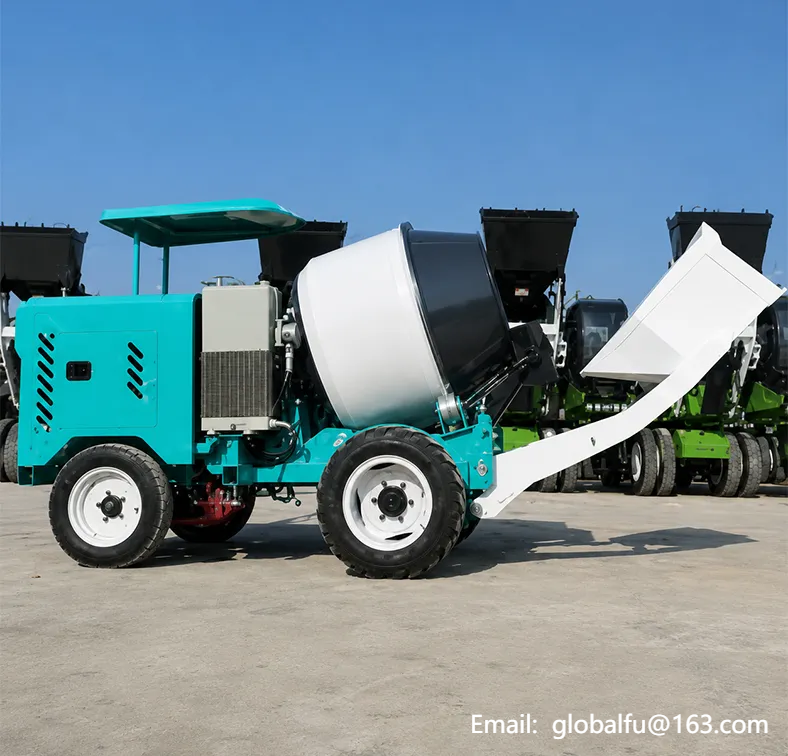
The 0.32 CBM model and the RATO R740-1
The smallest unit in the range is the one that gets dismissed fastest and shouldn’t be. At 0.32 CBM it produces roughly a third of a cubic metre per batch, which suits repair works, precast yards making small elements, rural housing, and any job reached through a gate a larger machine cannot pass. It runs the RATO R740-1 engine.
Ask two questions about any small engine before ordering: whether that engine family is serviced locally, and which emissions tier it is certified to for your destination. The second question decides whether the machine can be imported at all.
Drum rotation: 270 vs 290 degrees
The rotation figure describes how far the drum can swing across the machine, and it decides where you can discharge from. Wider rotation means you can position the machine on the access track and still reach a form that sits off to one side, instead of reversing into place for every pour.
Where this matters most:
- Wall and column forms reached from one side, where the discharge chute has to come round to meet the form rather than the machine coming round to meet the chute
- Narrow trench and footing pours where the machine cannot straddle the excavation
- Repetitive pours along a line, such as kerbs, drainage channels or fence bases, where saving one reversing manoeuvre per batch compounds across a shift
- Discharging into a pump hopper or skip parked at a fixed position
On an open slab pour where the machine can drive anywhere, the difference between 270 and 290 degrees is close to irrelevant. Confirm the rotation figure for the specific model you are quoting, and if a particular form geometry is the reason you are buying, describe that geometry when you enquire.
4×4 drive and the sealed worm-gear rotary table
Every unit in the range is 4×4. On a self-loading mixer this is not a marketing tick. The machine is at its heaviest at the moment it is fully loaded and has to climb away from the stockpile, often across the softest ground on the site, and a two-wheel-drive machine in that situation either stalls or churns the haul track into something the next machine cannot cross.
The rotary table is the component worth understanding in detail, because it is the one that decides whether the machine is still working in year four. It carries the drum and lets it rotate, which means it takes the full weight of a loaded drum while turning, in an environment saturated with the two things that destroy bearings: abrasive dust from cement and aggregate, and water from washing down. The Kaishun table is a sealed worm-gear design carrying a 5-year warranty, longer than the 1-year or 2,000-hour machine warranty.
Compared with the general run of self-loading mixers in this class, where the rotation assembly is usually listed as a line item on the spec sheet with no sealing detail and no separate warranty term, an explicitly sealed table with its own warranty period is a difference you can hold a supplier to. It is worth asking any supplier, including this one, for the seal arrangement and the greasing interval in writing.
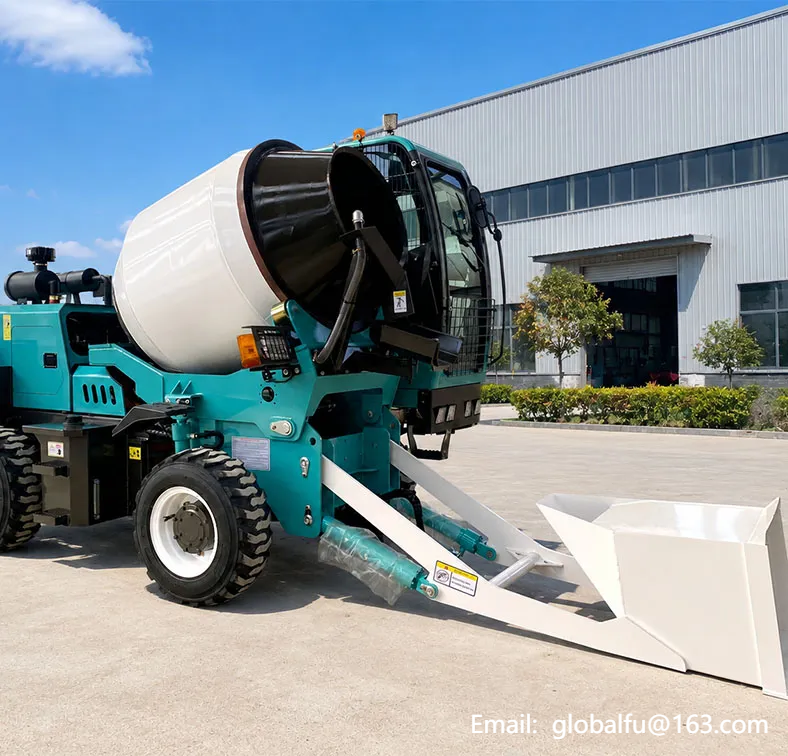
Trade-offs worth knowing before you commit
Self-loading mixers earn their place on jobs where ready-mix cannot reach, cannot arrive on a reliable schedule, or is priced high enough that on-site production pays back quickly. They are not the right answer everywhere.
Where the case is strong:
- No batching plant within economic haul distance
- Pours are frequent but individually small, so ready-mix deliveries would be part-loads
- Labour cost or availability makes a one-operator setup attractive
- The machine will also be used for material handling between pours
Where it is weak, stated plainly:
- Batch consistency depends on the operator and on stockpile discipline. Damp aggregate that nobody accounts for changes the water content of every batch that day. A plant with automated moisture compensation does not have this problem. If your specification requires tight, documented, repeatable strength results across a large structural pour, understand what your quality regime will need to look like before you buy.
- Sustained high-volume pours are the wrong application. A large continuous slab or a raft foundation wants a plant and a truck fleet. Trying to feed one from a self-loading mixer means cold joints where the pour outran the machine.
- The machine is a single point of failure. When it is down, you have lost your loader and your mixer at once. Spares availability and response time should carry real weight in supplier selection, not be treated as a footnote after price.
- Operator training is a real cost. One person is now batching concrete, not just driving. Budget the time.
What it costs
Kaishun does not publish prices for this range, and this article will not invent one. Pricing is quotation-based, from the factory without a middle layer of trading companies, and it moves with capacity, engine brand and emissions tier, drum rotation, tyre specification, cab and safety equipment, optional attachments, and destination and shipping mode. Request a written quotation against a defined configuration. Prices you find quoted in the open market for this machine class are usually attached to an unstated specification and are not comparable to each other.
Two cost items sit outside the machine price and are routinely missed: import duty and any type-approval or homologation cost in the destination country, and the first year of consumables and wear parts.
Compliance and paperwork to settle before shipping
Kaishun self-loading mixers are covered by ISO 9001 quality management certification and carry CE marking.
Emissions is the item that most often derails an import. Non-road diesel machinery is regulated under EU Stage V in Europe and US EPA Tier 4 Final in the United States. These are the standards that apply to this machine class. Euro V is an on-road vehicle standard and does not apply here; if you see it quoted for construction machinery, in any supplier’s documentation, treat it as a wording error and ask which non-road tier the engine actually meets. Getting this confirmed in writing before production starts is far cheaper than discovering it at the destination port.
Ask for the engine make, model and emissions certification, and confirm the engine brand is serviceable in your country. Kaishun supplies to 50+ countries and the destination requirement should be specified at the order stage, not assumed.
FAQ
Q: What is the largest self-loading concrete mixer Kaishun makes?
A: The model listing runs to 4.0 CBM output capacity. Some category copy quotes a higher figure; treat 4.0 CBM as the ceiling until you have written confirmation otherwise.
Q: How do I convert output capacity into cubic metres per day?
A: Multiply batch size by the number of complete cycles you can achieve in a shift. Time a full cycle on your own site, including travel to the stockpile and back. On constrained sites, cycle time matters more than drum size.
Q: Is 290 degree drum rotation worth paying for over 270?
A: It depends entirely on your pour geometry. For formwork reached from one side, trench pours, and repetitive linear pours, wider rotation removes a repositioning manoeuvre from every batch. For open slab work where the machine can drive anywhere, the benefit is marginal.
Q: What does the 5-year rotary table warranty actually cover?
A: The sealed worm-gear rotary table carries a 5-year warranty, separate from the 1-year or 2,000-hour machine warranty. Request the written warranty document with your quotation so the covered failure modes and the maintenance conditions attached to it are clear before purchase.
Q: Can the machine be finished in our company colours?
A: Yes. Colour, logo and nameplate customization is available, with a minimum order quantity as low as 1 unit for simple branding, and an NDA signed where required.
Q: What support exists after delivery?
A: 1-year or 2,000-hour global warranty, 150+ service agencies and 10+ overseas spare parts centres, plus lifetime online technical support and original spare parts supply. Confirm which agency covers your country before ordering.
Q: What price should I budget?
A: No public price range is published for this line. Pricing is quotation-based and configuration-dependent. Send your capacity, engine, emissions tier and destination requirements to get a written quotation.
Before you send an enquiry
Three numbers make a quotation useful rather than generic, and none of them require you to have chosen a model yet: your peak daily concrete requirement in cubic metres, your worst-case cycle route measured in metres and gradient, and your destination country’s emissions tier. Add your pour geometry if formwork access is the reason you are buying.
The question this article has not covered is what to pair the mixer with. Sites running self-loading mixers frequently need a wheel loader for stockpile management once concrete volume rises past what one machine can feed itself, and the sizing logic for that pairing works differently. That is a separate calculation, and worth doing before you finalise the mixer specification rather than after.











 August 19, 2026