Kaishun Engineering Team | Technical Content, Qingdao Kaishun Imp & Exp Co., Ltd. | Published: 20 August 2026
Specifications reflect the Kaishun catalog as of August 2026. Load charts and chassis configuration are model-specific and issued with the quotation.
Working height is the vertical distance from the ground to a standing operator’s feet plus about two metres. It is the number every supplier prints. The number that decides whether you win the job is horizontal outreach at a given height with the platform loaded, and that comes from the load chart, not the headline.
The Kaishun range documents two working heights, 28 m and 30.5 m, with a 200 kg platform rated load. Everything below is about reading those figures correctly.
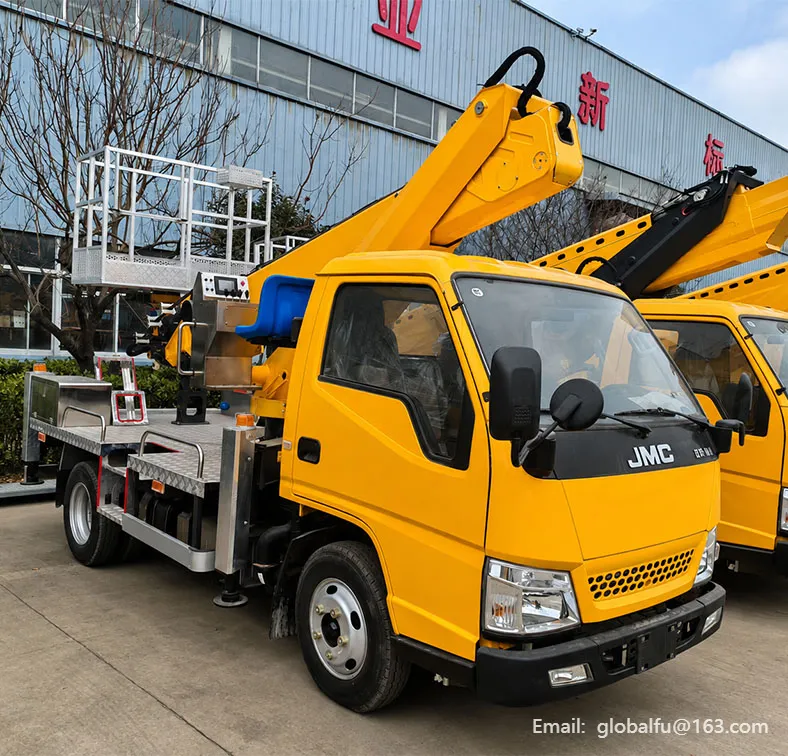
The reach envelope, not the reach number
Ask a supplier for maximum outreach and they will quote you a single figure. That figure is achieved at one specific boom angle, usually low, with the platform at a modest height, and often at reduced platform load. It describes one point on the edge of a shape.
The shape is what matters. A truck-mounted aerial platform’s working envelope narrows as the boom rises: maximum outreach and maximum height do not happen together, because the further the platform sits from the truck’s centre of rotation, the greater the overturning moment the outriggers and chassis have to resist. A 30.5 m machine at full height may have less usable outreach than the same machine working at 18 m.
This is why a 28 m unit sometimes does a job a 30.5 m unit cannot. If the obstacle is a hedge, a parked car row, a rail line or a building setback, you are not asking for height. You are asking to stand 9 metres back and still reach 14 metres up, and that combination either falls inside the envelope or it does not.
Three things follow from this:
- Request the load chart before you compare machines, not after you have shortlisted on height. Ask for it as a diagram showing the working envelope, with the curve for the full 200 kg platform load identified separately from any reduced-load curve.
- Measure your worst access position on site, not your typical one. The job that justifies the purchase is usually the awkward one.
- Check whether the quoted outreach assumes full outrigger deployment. Many envelopes shrink substantially when outriggers are only partially extended, which is exactly the condition you face in a narrow street.
That third point is where the machine’s control system stops being a spec-sheet feature and starts being the thing that keeps the truck upright.
Outriggers, interlock and levelling as one safety chain
Most category content lists outrigger interlock, hydrostatic auto-levelling and the emergency pump as three separate bullet points. On the machine they are one dependent sequence, and understanding the order is what tells you which failure modes are covered.
The sequence runs like this:
- The truck is positioned and the outriggers deploy, transferring load off the suspension and onto prepared bearing points.
- Hydrostatic auto-levelling brings the turntable level, correcting for ground slope, because a boom rotating on an out-of-level turntable changes its overturning moment as it swings.
- The outrigger interlock confirms deployment and levelling before it permits boom operation. Until that condition is satisfied, the boom does not move.
- Only then does the boom become available, with 360 degree continuous rotation across the full circle.
- The emergency pump provides a means of retrieving the platform if primary hydraulic power is lost with an operator at height.
The interlock is the link that matters most, because it removes the single most common cause of aerial platform overturn from the operator’s discretion. An operator under schedule pressure, on a job that has already run late, on ground that looks firm enough, does not get to decide to skip a step. The machine decides.
CAN bus control is what makes this practical rather than a mess of relay logic. It carries status from the outrigger sensors, levelling system and boom position back to the control points, and it is also what makes fault diagnosis a matter of reading a code rather than tracing a loom. Both platform and ground controls are available, with remote and manual operation.
Compared with the general run of truck-mounted units in this class, where marketing copy treats these as an unranked feature list, the useful question to put to any supplier is: what exactly is the interlock condition, and what does the machine do when it is not met? Ask for the answer in writing.
Two limits worth stating plainly. The interlock confirms the outriggers are deployed and the turntable is level. It does not, and cannot, confirm that the ground under the outrigger pads will hold. Spreader pads sized to the ground bearing pressure are the operator’s responsibility on every setup, and no control system substitutes for them. Nor does auto-levelling extend the machine’s slope capability without limit; it corrects within a range, and beyond that range you reposition the truck.
Why a truck-mounted unit is not a self-propelled machine with wheels
This is the misconception that costs the most money, because it is usually discovered after delivery.
A truck-mounted aerial platform is a road vehicle carrying an access system. Its advantage is that it drives to site on the highway at road speed, sets up, works, stows and drives to the next site, all in a shift, with no low-loader and no transport permit for a routine move. For utility, telecom and facade work spread across a city or a service territory, that is the entire economic case.
Its limitation is the same fact seen from the other side. It travels on a truck chassis with road tyres and road ground clearance. On unprepared ground, soft fill, a muddy site compound or a slope, it does not go where a rough-terrain self-propelled machine goes, and once it is stuck it needs recovery rather than a change of technique.
The dividing question is not how high you need to reach. It is what the last 200 metres to the work position looks like:
- Made-up road, hardstanding or paved surface all the way in, and multiple locations per day — truck-mounted is the right class.
- A single location worked for weeks, reached across a construction site — a self-propelled machine that stays on site is usually the better answer, even though it needs transport to get there.
- Mixed, but always with a hardstanding setup position available — truck-mounted, and specify your setup footprint carefully.
- Genuinely soft or graded ground at the setup point — neither answer is automatic, and ground preparation becomes part of the method statement rather than an afterthought.
Buyers sometimes try to resolve this by asking for the truck-mounted unit on an all-wheel-drive chassis. That helps with traction on the approach. It does not change outrigger bearing pressure at the setup position, which is the constraint that actually governs whether you can work.
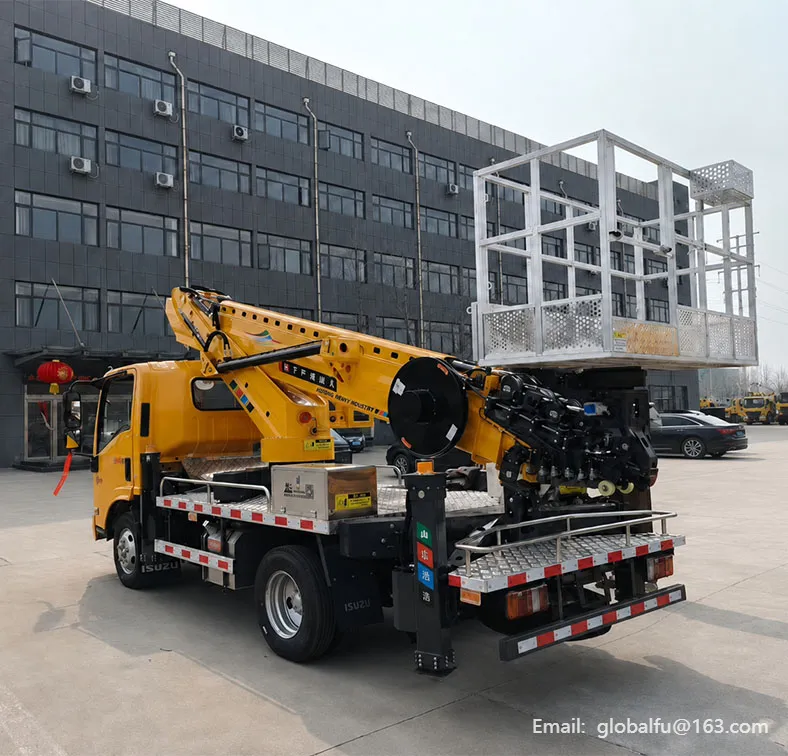
The 200 kg platform figure
Rated platform load in this range is 200 kg. Treat it as a budget to be spent rather than a headline number, because everything in the platform draws against it: the operators themselves, tools, and the materials being installed.
Two people in work clothing with boots and harnesses will use a large share of that budget before a single tool goes in the basket. Add a cordless tool kit, a coil of cable, replacement lamps or a section of cladding, and the arithmetic gets tight quickly. Work out your actual loaded weight for the task you buy the machine for, and check it against the load chart at the outreach you need, because on many machines the outreach available at full rated load differs from the outreach available with a lighter platform.
If your work routinely requires two operators plus significant material at long outreach, say so at enquiry stage. That requirement drives the specification more than working height does.
Where these machines earn their keep, and where they do not
Strong fit:
- Street lighting, overhead line and traffic signal maintenance, where the work is dispersed and each location takes under a day
- Telecom pole and antenna work along a route
- Facade cleaning, signage and glazing access on paved frontage
- Municipal tree work and building maintenance across a portfolio of sites
- Any operation where transporting a self-propelled machine between locations would consume more time than the work itself
Weak fit, stated as it is:
- Setup footprint is unforgiving. Fully deployed outriggers need their space, and in a narrow street or a car park with adjacent parked vehicles you either get that space, work at reduced envelope, or do not work. Survey the setup position, not just the work position.
- The chassis is a second maintenance stream. You now own a truck as well as an access machine, with vehicle inspection, roadworthiness, driver licensing and chassis servicing running alongside the access system’s own inspection regime. Fleets that budget only for the access side get surprised in year two.
- Idle time is expensive. A truck-mounted unit represents a chassis and an access system tied up together. On a project where the platform is needed intermittently, that capital sits still, and rental may be the better commercial answer for those periods.
- Ground bearing pressure limits urban work more than height does. Basements, service ducts, cellar lights and buried utilities under the setup position are a real constraint in older city centres, and no amount of working height solves it.
Certification and what to confirm before shipping
Kaishun aerial platform trucks are covered by ISO 9001 quality management certification and carry CE marking.
The technical standard that governs this machine class in Europe is EN 280, covering mobile elevating work platforms, and it is the reference behind the stability, structural and control requirements described above. CE marking for machinery placed on the EU market rests on the EU Machinery Regulation (EU) 2023/1230. If the EU is your destination, put the conformity route and the applicable standard in the contract rather than assuming the marking on the plate settles it.
For any destination, four items belong in the order documentation:
- The load chart for the exact configuration you are buying, at 200 kg platform load
- The chassis specification, including emissions certification for the destination market and confirmation that the chassis brand is serviceable locally
- Vehicle type approval or homologation requirements in the destination country, which apply to the truck as a road vehicle independently of the access system’s conformity
- The declaration of conformity and the standards referenced in it
That second and third item catch buyers out regularly. The access system and the road vehicle are assessed under different regimes, and clearing one does not clear the other.
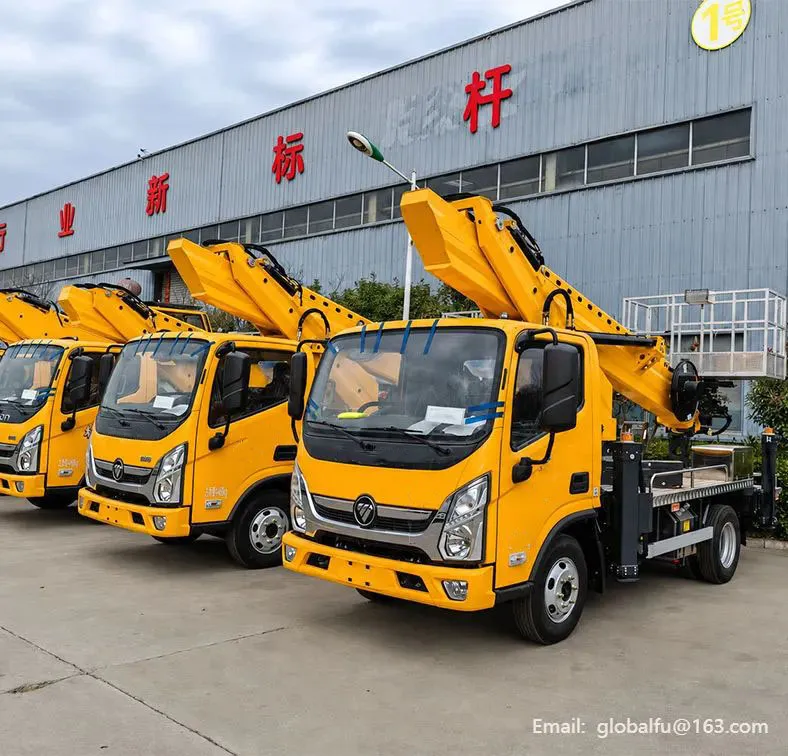
Pricing
Kaishun publishes no price list for this range, and no figure is invented here. Quotation is configuration-driven, direct from the factory. The variables that move the number: working height, chassis make, model and emissions tier, platform and control specification, outrigger configuration, and destination and shipping mode. Chassis choice alone can swing the total substantially, which is why cross-quotations from different suppliers rarely compare like with like unless the chassis is pinned down first.
Send a defined specification and ask for a written quotation against it.
FAQ
Q: What working heights does Kaishun offer in truck-mounted aerial platforms?
A: Two are documented: 28 m and 30.5 m, both with a 200 kg platform rated load. Other heights are not listed; ask before assuming availability.
Q: What horizontal outreach do these machines have?
A: Outreach varies continuously with boom height and platform load, so no single figure describes it. Request the load chart diagram for the specific model and confirm the outreach available at your required height with the full 200 kg on board.
Q: What does 360 degree continuous rotation change in practice?
A: The turntable rotates through the full circle without a stop, so the boom can be swung to any bearing from one setup position rather than repositioning the truck. On a job requiring work on more than one face from a single parking position, it removes setup cycles.
Q: Can the platform be recovered if hydraulic power fails at height?
A: An emergency pump is fitted for that purpose. Its operation should be covered in operator training and rehearsed, not read about for the first time during an incident.
Q: Will the machine work on a slope?
A: Hydrostatic auto-levelling corrects the turntable within a defined range, and the outrigger interlock prevents boom operation until level is achieved. Beyond that range the truck must be repositioned. Confirm the slope limit for your model at the quotation stage.
Q: Is a truck-mounted platform suitable for a construction site?
A: Only where a hardstanding or prepared setup position is available at the work location. On soft or graded ground a self-propelled rough-terrain machine is the appropriate class.
Q: What price should I budget?
A: No public price range is published. Pricing is quotation-based and depends heavily on chassis selection. A written quotation against a defined specification is the only meaningful figure.
What to settle before you enquire
Bring three things to the enquiry and the quotation becomes specific instead of generic: the worst-case setup position you expect to work from, measured as distance from the work face and available width for outriggers; your loaded platform weight for the actual task; and your destination country’s chassis emissions and type-approval requirements.
About the author
This article was prepared by the Kaishun Engineering Team at Qingdao Kaishun Imp & Exp Co., Ltd., a direct-factory manufacturer of construction machinery across nine equipment categories, with 20+ years in export manufacturing and 100+ invention and utility model patents. Aftersales coverage runs to 150+ service agencies and 10+ overseas spare parts centres, with a 1-year or 2,000-hour warranty and lifetime online technical support. For load charts or a written quotation: +86 176 8575 5030 (WhatsApp / WeChat) or Contact this email: [email protected]. Enquiries answered within 24 hours.











 August 20, 2026