Kaishun Engineering Team | Construction Equipment Content Team | Published: September 7, 2026
A self-loading concrete mixer‘s price is set by capacity band, engine brand and emissions tier, drum rotation range, rotary table sealing, cab and safety options, freight mode, and destination-market duty and type approval. Change any one variable and the number moves — which is why a single published price never matches what a buyer actually pays.
Capacity Band Sets the Baseline
Output capacity is the first fork in the pricing tree. Kaishun’s self-loading mixer range covers 0.32, 0.5, 0.8, 1.2, 1.8, 2, 3.5 and 4.0 CBM models — a roughly twelve-fold spread in output between the smallest and largest unit. Steel, drum casting, hydraulic pump sizing and axle rating all scale with capacity, so this single choice does more to move the final number than any other line item on the spec sheet.
Engine Brand and Emissions Tier
The 0.32 CBM model ships with a RATO R740-1 diesel engine. Larger models in the range are configured against destination-market emissions requirements — EU Stage V for machinery entering the EU, and US EPA Tier 4 Final for the US market. An engine built to meet Stage V or Tier 4 Final costs more to produce than one built to a less stringent tier, and that difference carries straight through to the quoted price. This is also the variable most likely to be invisible on a marketplace listing that doesn’t state which market the unit is certified for.
Drum Rotation Range
Drum rotation across the Kaishun range comes in 270° or 290° variants. The wider rotation angle changes discharge geometry and, on some configurations, the reinforcement built into the drum mount — a mechanical difference, not a cosmetic one, and one that shows up in cost.
Rotary Table Sealing
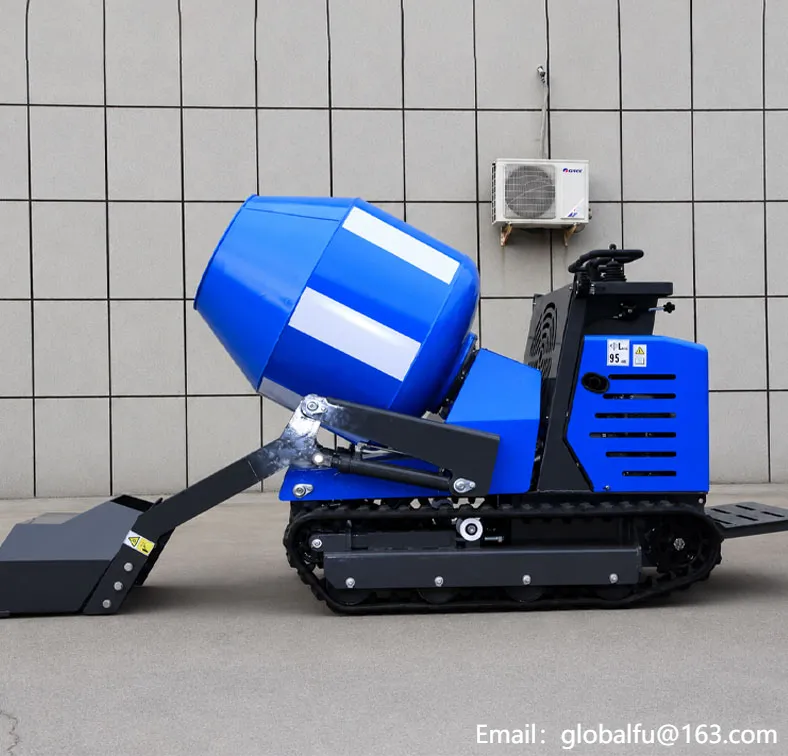
Every model in the range uses a sealed worm-gear rotary table, backed by a 5-year warranty on that component specifically. A sealed rotary table with a five-year warranty commitment reflects a different manufacturing and materials standard than an unsealed or shorter-warranty equivalent, and the certification and testing behind that warranty period is priced into the unit.
Cab, Safety and Attachment Options
4×4 drive is standard across the range, but cab configuration, operator protection features and any attachment options selected at order time are add-ons layered on top of the base machine price — the same way trim level changes the price of a base vehicle. None of these are published as a menu with figures attached; they’re confirmed during the quote conversation once the buyer’s operating conditions are known.
Freight Mode and Container Consolidation
A single mixer shipped alone pays a different per-unit freight cost than the same mixer shipped as part of a consolidated container load alongside other Kaishun equipment — wheel loaders, gensets, or other units bound for the same destination. Compared with sourcing mixers and material-handling equipment from separate suppliers and paying separate freight lanes for each, consolidating into one load from one factory changes the freight line meaningfully. This is a genuine cost lever, but it only applies once a buyer’s full order is known — which is one more reason a generic price can’t capture it.
Destination Duty and Type Approval
Import duty rates and machinery type-approval requirements differ by country and sometimes by port. A mixer landing in a market with a low import duty and straightforward type approval costs less delivered than the identical machine landing somewhere with higher duty and a longer approval process — a variable that has nothing to do with the machine itself and everything to do with where it’s going.
What a Real Quote Actually Requires
- State the destination country. Duty, type approval and emissions tier all key off this before anything else can be priced.
- Confirm the output capacity needed for the job, not the largest or smallest model by default — capacity drives cost more than any other single variable.
- Choose the engine brand and confirm the required emissions certification for that destination market.
- Decide whether the unit ships alone or as part of a consolidated load with other equipment, since this changes the freight line materially.
- List any cab, safety or attachment options needed for the operating environment before requesting the final figure.
A quote built on these five inputs is a real number. A price with none of them behind it is a guess dressed up as an answer.
The Honest Bottom Line on Price
Kaishun does not publish prices or price ranges for any product line — a direct-factory, no-middleman positioning rather than a gap in transparency. Anyone quoting a specific figure for a self-loading mixer without first confirming destination country, capacity and engine choice is quoting a configuration nobody actually orders. The accurate answer to “how much does a self-loading mixer cost” is: it depends on the five inputs above, and getting a real number takes a quote request, not a marketplace search.
FAQ
Q: Why won’t Kaishun just publish a starting price?
A: Because a starting price would represent the smallest capacity, cheapest engine option and no freight consolidation — a configuration few buyers actually order, and one that would mislead anyone comparing it against a fully specified machine.
Q: Is a cheaper listed price on a marketplace site automatically a worse machine?
A: Not automatically, but it’s frequently a smaller-capacity unit, a lower emissions tier, or a machine without the certification scope a buyer needs — the comparison only holds if all of those variables match.
Q: Does shipping one mixer alone cost more per unit than shipping several together?
A: Generally yes, since per-unit freight cost drops when a container is filled to capacity rather than carrying one machine with unused space.
Q: What’s the fastest way to get an accurate number?
A: Provide the destination country, target capacity and preferred engine brand in one enquiry — those three answers let a supplier skip several rounds of back-and-forth and quote directly.











 September 07, 2026