Kaishun Engineering Team | Construction Equipment Content Team | Published: September 2026
A poorly selected scissor lift can create the wrong working height, waste floor space, or limit your team’s productivity. The right scissor lift platform should match the load, working height, ground conditions, mobility needs, and application. Understanding these factors makes equipment selection safer and more cost-effective.
A scissor lift is a lifting machine that uses linked scissor arms to raise a working platform vertically. Depending on the design, it can be hydraulic, electric, pneumatic, stationary, mobile, or crawler-mounted. The right model depends on required working height, platform size, load capacity, terrain, indoor or outdoor use, and the way workers need access to elevated areas.
What Is a Scissor Lift and How Does a Scissor Lift Platform Work?
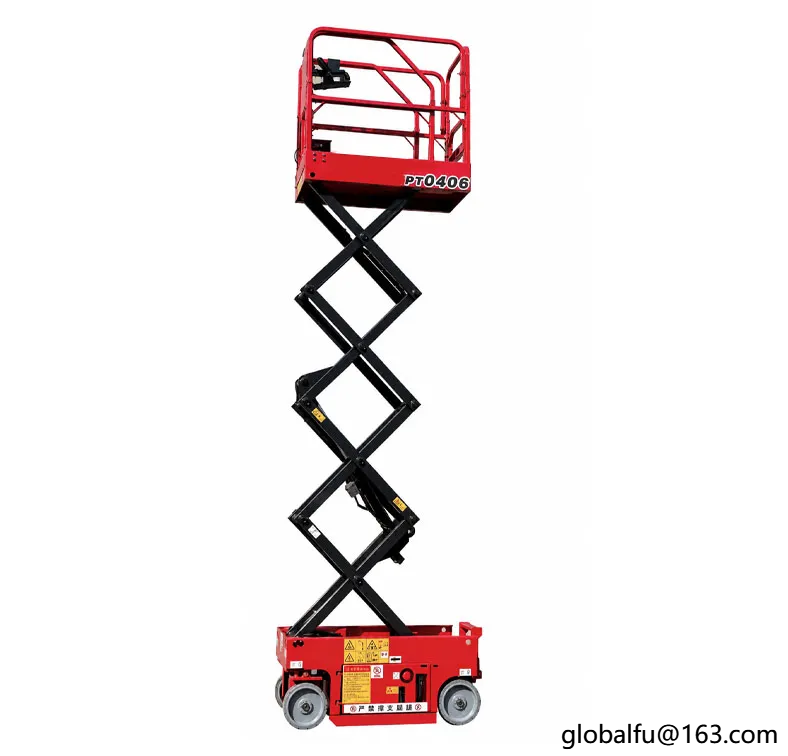
A scissor lift is a type of vertical lift platform designed to raise workers, tools, or materials to an elevated position. Its name comes from the crossed scissor arms that extend and retract as the platform moves upward or downward.
Unlike a boom lift, which can move its platform horizontally through a boom, a scissor lift mainly provides vertical movement. This makes it particularly useful when workers need stable access directly above the machine.
A typical scissor lift platform includes:
- Base frame
- Scissor arms
- Lifting cylinders
- Hydraulic power unit
- Working platform
- Guardrails
- Drive system on mobile models
- Safety control system
The scissor lift mechanism converts hydraulic or other mechanical force into vertical movement. When the lifting system generates sufficient force, the scissor arms extend and elevate the platform. When the system releases the lifting force, the platform can lower under controlled conditions.
This straightforward design gives the equipment a wide range of applications, from warehouse maintenance to construction sites and industrial installation.

How Does a Hydraulic Scissor Lift Work?
A hydraulic scissor lift uses pressurized hydraulic fluid to move one or more lifting cylinders. The cylinders act on the scissor arms and cause the platform to rise.
The basic operating process is:
Hydraulic power → cylinder movement → scissor arms extend → platform rises
When the operator needs to lower the platform, the hydraulic system controls the return flow so the platform can descend in a controlled manner.
A hydraulic lift can provide high lifting force in a relatively compact structure. That is one reason hydraulic equipment remains widely used for lifting heavy loads and supporting industrial applications.
A typical hydraulic system may include:
- Hydraulic pump
- Hydraulic cylinder
- Hydraulic valve
- Oil reservoir
- Hoses and fittings
- Pressure-control components
For buyers comparing hydraulic lift tables and elevated work equipment, the important point is that hydraulic design is not simply about maximum lifting force. The system should also provide smooth movement, reliable control, and appropriate protection against unintended platform movement.
What Are the Main Types of Scissor Lifts?
There is no single type of scissor lift for every application. Equipment can be classified by power source, mobility, lifting capacity, platform configuration, or working environment.
Common categories include:
| Type |
Main Characteristic |
Typical Application |
| Electric scissor lift |
Battery/electric drive |
Indoor construction and maintenance |
| Hydraulic scissor lift |
Hydraulic lifting system |
Industrial and construction applications |
| Small scissor lift |
Compact dimensions |
Tight working areas |
| Mobile scissor lift |
Easy relocation |
Multiple work areas |
| Stationary scissor lift |
Fixed installation |
Material handling |
| Crawler scissor lift |
Tracked undercarriage |
Uneven or softer ground |
| Heavy duty scissor lift |
Higher load capability |
Industrial applications |
| Pneumatic scissor lift |
Air-powered lifting |
Specialized environments |
Some machines combine these characteristics. For example, a compact mobile scissor lift can use an electric drive and hydraulic lifting system at the same time.
This is why buyers should not compare machines only by one label. The better approach is to evaluate the complete equipment configuration.
Electric Scissor Lift or Hydraulic Scissor Lift: Which Is Better?
An electric scissor lift is often selected when the machine will work in environments where low emissions, low noise, and controlled movement are important.
Typical applications include:
- Warehouses
- Commercial buildings
- Indoor installation
- Facility maintenance
- Electrical work
- Industrial plants
An electric drive system and hydraulic lifting system can also work together. In other words, “electric” and “hydraulic” are not always competing categories.
An electric machine may use electric power to drive the wheels and a hydraulic system to raise and lower the platform.
For outdoor construction, the selection may instead focus on:
- Ground clearance
- Tire configuration
- Gradeability
- Platform size
- Working height
- Terrain capability
The right scissor lift depends on the complete operating environment rather than the power source alone.
What Is a Small Scissor Lift and When Should You Use One?
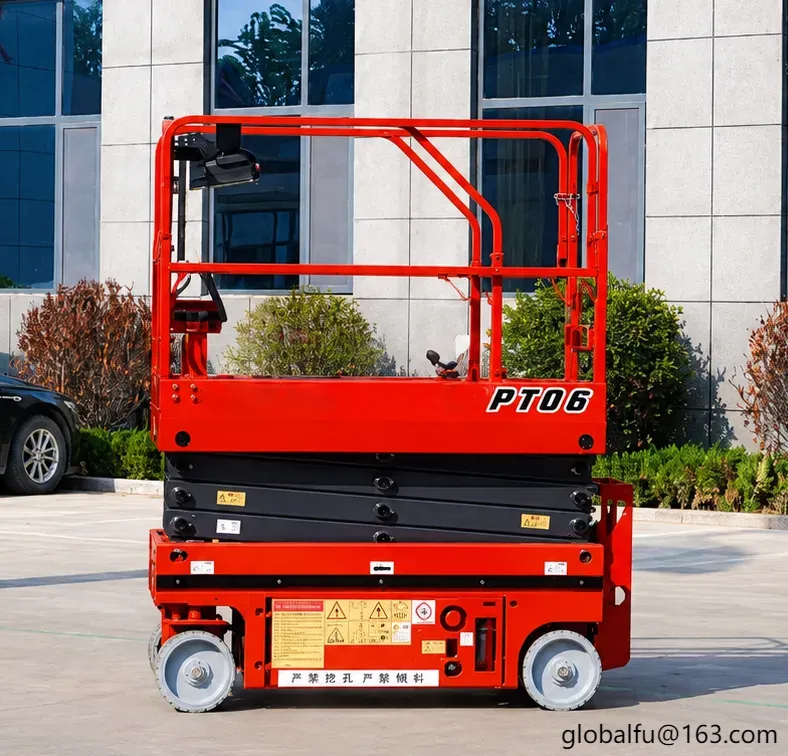
A small scissor lift is designed for applications where working space is limited and the required load or height is relatively modest.
A small scissor configuration can be useful for:
- Indoor maintenance
- Warehouse inspection
- Retail facility work
- Ceiling installation
- Electrical maintenance
- Equipment servicing
Compact dimensions make these machines easier to position in tight spaces.
For example, a compact scissor lift may be more practical than a larger machine when workers need to move between storage racks or operate inside a building with restricted access.
However, smaller does not automatically mean better.
Buyers should still confirm:
- Platform capacity
- Platform size
- Working height
- Machine width
- Turning radius
- Battery or power requirements
If the application involves frequent movement between different locations, a mobile design may offer better productivity.
Stationary Scissor Lift vs. Mobile Scissor Lift
A stationary scissor lift is generally installed in a fixed position. It is often used as a lifting solution for materials rather than as a mobile aerial work platform.
Typical applications include:
- Production lines
- Warehouses
- Loading areas
- Material handling
- Industrial platforms
A stationary scissor lift table can raise a pallet or other load to a more convenient working level. This can reduce repeated bending and manual lifting.
By contrast, mobile scissor lifts are designed to move between work areas.
A mobile scissor lift table can be equipped with wheels or casters, depending on the design and application. This makes it useful when operators need to reposition the equipment during a workday.
The decision is simple:
Fixed production point → stationary lift
Multiple work areas → mobile lift
When Should You Consider a Heavy Duty Scissor Lift?
A heavy duty scissor lift is designed for applications where the equipment must handle higher loads or more demanding operating conditions.
Potential applications include:
- Industrial maintenance
- Machinery installation
- Heavy material handling
- Manufacturing facilities
- Construction sites
A heavy-duty machine may require stronger:
- Scissor arms
- Platform structure
- Hydraulic components
- Base frame
- Safety systems
When handling heavy loads, buyers should never select a machine only by platform dimensions. The rated load must be matched to the actual working requirement.
For industrial applications, consider both:
Maximum load + load distribution
A concentrated load placed at one side of the platform may create different operating conditions from an evenly distributed load.
Can Pneumatic Scissor Lifts Replace Hydraulic Models?
A pneumatic scissor lift uses compressed air instead of a conventional hydraulic lifting circuit.
Pneumatic systems can be attractive for specialized applications where air power is already available or where a particular operating environment favors pneumatic equipment.
However, hydraulic lifting remains a common solution for many construction and industrial machines because it provides strong lifting force and precise control.
A pneumatic design may be considered when:
- Compressed air is readily available
- The application has specific environmental requirements
- The lifting load is compatible with the equipment
- The customer has a specialized system requirement
For most general construction applications, buyers should compare the actual machine specifications rather than assuming pneumatic equipment is automatically better.
How Do You Choose the Right Scissor Lift Platform?
The correct scissor lift platform should be selected around the work rather than around the machine name.
Start with six questions:
1. What Is the Required Working Height?
Working height determines how high the operator needs to reach.
Do not confuse:
- Platform height
- Maximum lift height
- Working height
The correct specification depends on the actual elevated work area.
2. What Load Must the Platform Carry?
Calculate:
Operators + tools + materials = required platform load
Include everything that will actually be carried.
3. Where Will the Machine Work?
Determine whether the equipment will operate:
- Indoors
- Outdoors
- On concrete
- On gravel
- On uneven ground
- In restricted spaces
4. Does the Machine Need to Move?
If workers must access several locations, consider a mobile design.
5. How Large Should the Platform Be?
A larger platform can improve working comfort and allow more tools to be carried, but it can also increase machine dimensions.
6. What Safety Features Are Required?
Look for appropriate:
- Guardrail
- Emergency controls
- Platform protection
- Tilt protection
- Braking system
- Emergency lowering
How Does Platform Size Affect Productivity?
Platform size has a direct effect on how workers organize their tools and materials.
A larger platform can provide more room for:
- Operators
- Tools
- Installation components
- Maintenance equipment
This can improve productivity when the job requires several tools or materials to remain on the platform.
However, a larger platform also increases the overall footprint.
For a warehouse with narrow aisles, a compact scissor lift may provide better efficiency than a larger model.
For construction sites or industrial maintenance, a larger platform may reduce the number of trips required to bring tools to the working area.
The right balance is:
Enough platform area for the job without creating unnecessary size.
How Can a Scissor Lift Improve Workplace Ergonomics?
Workers often need to perform repetitive tasks at elevated positions.
Without appropriate equipment, they may rely on ladders, temporary structures, or manual lifting methods.
A scissor lift table or elevated work platform can bring the working position closer to the operator’s preferred height.
This can:
- Improve ergonomics
- Reduce unnecessary bending
- Reduce repeated climbing
- Provide easier access to elevated work
- Improve workflow
For material handling, a hydraulic lift can raise a pallet to a convenient height.
For maintenance, a working platform can raise workers to the correct position.
For construction, a mobile lift can move with the work team.
The machine should therefore be viewed not only as lifting equipment but also as a lift solution designed around the operator and the task.
What Applications Use Scissor Lift Platforms?
A scissor lift has a wide range of applications because vertical lifting is needed across many industries.
Common applications include:
Construction Sites
Workers can use a scissor lift for:
- Ceiling installation
- Electrical installation
- Building finishing
- Mechanical installation
- Interior construction
Warehouse
A warehouse may use a lift platform for:
- Inventory access
- Lighting maintenance
- Storage system maintenance
- Equipment inspection
Industrial Use
Industrial facilities may use lifting equipment for:
- Machine servicing
- Production-line maintenance
- Inspection
- Component installation
Material Handling
A scissor lift table can raise a pallet or production component to an ergonomic working position.
This makes hydraulic lift tables particularly useful where operators repeatedly load and unload materials.
How Should You Operate a Scissor Lift Safely?
Operating a scissor lift requires training, inspection, and attention to the working environment.
Before operation, inspect:
- Tires or tracks
- Hydraulic components
- Platform
- Guardrails
- Controls
- Emergency systems
- Braking system
- Structural components
Operators should understand the manufacturer’s guidelines for operating the specific model.
Never exceed the rated platform load.
Workers should also understand how to:
- Raise the platform
- Lower the platform
- Stop movement
- Use emergency controls
- Respond to an equipment fault
The operator should work safely and keep the platform within the machine’s rated operating conditions.
A proper safety program should also consider overhead obstacles, ground conditions, weather, and nearby equipment.
What Safety Features Should a Scissor Lift Have?
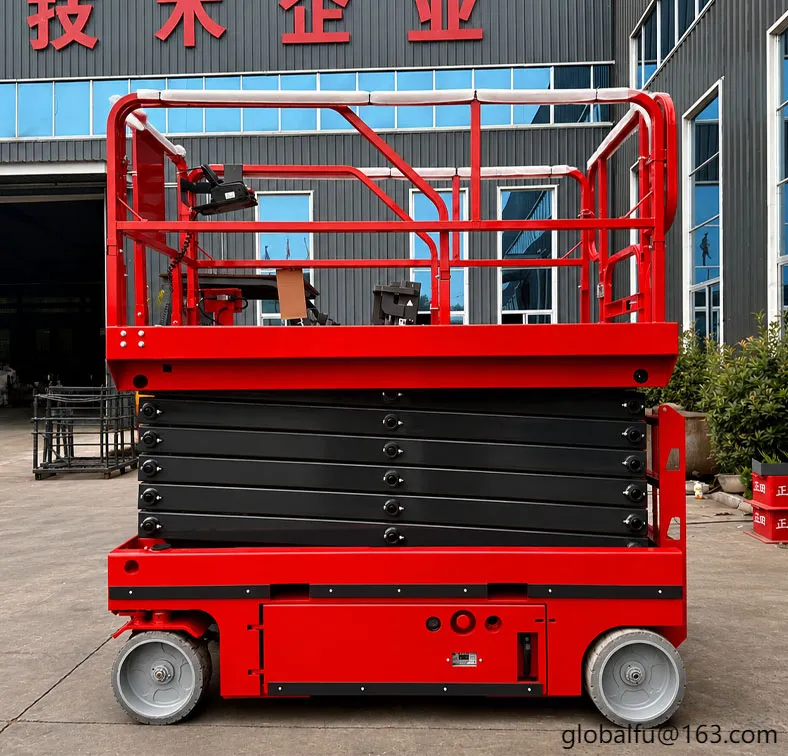
Important safety features depend on the model and application, but may include:
- Emergency stop button
- Emergency lowering system
- Tilt protection
- Automatic braking
- Guardrail system
- Platform gate
- Overload protection
- Fault diagnosis
Non-slip platforms can also help provide secure footing for operators.
The machine should be inspected and maintained according to the manufacturer’s instructions and applicable local safety standards.
Safety is not an accessory.
It is part of the machine-selection process.
Why Choose Kaishun for Scissor Lift and Construction Equipment Solutions?
Kaishun Machinery operates as a China-based B2B construction equipment supplier serving international contractors, EPC companies, equipment distributors, rental companies, mining projects, and engineering procurement teams.
Our aerial access equipment range includes:
- Self-propelled scissor lifts
- Crawler-mounted scissor lifts
- Truck-mounted aerial platforms
The scissor lift range includes compact and larger configurations designed for different construction and industrial requirements.
Kaishun also supplies a wider range of construction machinery, including:
This broader product portfolio allows customers to build an integrated equipment package instead of sourcing every machine separately.
For an international project, this can simplify:
- Equipment selection
- Technical communication
- OEM/ODM customization
- Consolidated shipping
- Spare-parts planning
- After-sales support
For example, an infrastructure contractor may require a scissor lift for elevated installation, a telehandler for material handling, a generator set for temporary power, and a self-loading concrete mixer for concrete production.
Kaishun can coordinate these requirements as part of a broader construction equipment procurement plan.
How Should B2B Buyers Compare Scissor Lift Manufacturers?
When comparing scissor lift manufacturers, do not focus only on the lowest equipment price.
Consider:
| Evaluation Factor |
Why It Matters |
| Working height |
Must match the job |
| Platform capacity |
Determines usable load |
| Platform size |
Affects operator efficiency |
| Drive system |
Determines mobility |
| Hydraulic system |
Affects lifting performance |
| Safety features |
Supports safe operation |
| Machine dimensions |
Important for site access |
| Spare parts |
Reduces downtime |
| Customization |
Supports project requirements |
| After-sales support |
Important for long-term ownership |
For equipment distributors and importers, supplier capability is equally important.
You may need:
- OEM branding
- Customized configuration
- Multiple machines
- Consolidated shipping
- Spare parts
- Technical documentation
This is where a manufacturer with a broader construction equipment portfolio can provide additional value.
What Should You Include in a Scissor Lift Inquiry?
If you are looking for a scissor lift for sale, provide the supplier with specific project information.
A useful inquiry should include:
- Required working height
- Platform capacity
- Platform size
- Indoor or outdoor application
- Ground conditions
- Required quantity
- Destination country
- Certification requirements
- Preferred power configuration
- Customization requirements
If you are considering a small scissor lift, explain the available working space.
If you need a heavy-duty machine, provide the actual load.
If the project involves uneven terrain, explain the ground conditions.
The more complete the information, the more accurate the equipment recommendation and quotation can be.
Frequently Asked Questions
What is a scissor lift platform used for?
A scissor lift platform is mainly used to provide vertical access to elevated work areas. Typical applications include construction, building maintenance, warehouse work, industrial maintenance, electrical installation, and material handling.
What is the difference between a hydraulic scissor lift and an electric scissor lift?
A hydraulic scissor lift describes the lifting mechanism, while an electric scissor lift generally describes the machine’s electric power or drive configuration. An electric machine can also use hydraulic components to raise and lower the platform.
Is a small scissor lift suitable for indoor use?
Yes. A small scissor lift can be suitable for indoor use when its dimensions, working height, platform capacity, turning radius, and floor conditions match the facility.
What is a stationary scissor lift used for?
A stationary scissor lift is commonly used for fixed lifting applications such as warehouses, production lines, loading areas, and industrial material handling. It can raise pallets and other loads to a convenient working height.
How do I choose the right scissor lift?
Consider the required working height, platform capacity, platform size, ground conditions, indoor or outdoor environment, mobility, power source, and safety requirements. These factors determine the most suitable scissor lift configuration.
Does Kaishun manufacture scissor lifts?
Yes. Kaishun Machinery supplies self-propelled and crawler-mounted scissor lift platforms as part of its aerial access equipment range. Kaishun also supplies truck-mounted aerial platforms and other construction machinery for international B2B projects.
Final Thoughts: Choose the Scissor Lift Around the Job
A scissor lift is more than a machine that moves a platform upward. It is a practical solution for providing stable access to elevated work areas, improving material handling, and supporting construction and industrial productivity.
The best equipment depends on the job.
Choose a compact design when space is limited.
Choose a mobile configuration when the working area changes.
Choose a stationary scissor lift table when material needs to be raised at a fixed point.
Choose a more robust hydraulic configuration when the project involves demanding loads or frequent operation.
And when the project involves difficult terrain or broader construction requirements, consider the complete equipment package rather than one machine in isolation.
Kaishun Machinery supports international contractors, EPC companies, distributors, rental businesses, and project procurement teams with aerial work platforms and integrated construction equipment solutions.
From scissor lifts and truck-mounted aerial platforms to self-loading concrete mixers, loaders, telehandlers, generator sets, trailers, and prefab houses, our team can help you build an equipment package around your actual project.
Tell Kaishun your required working height, platform load, application, destination country, and quantity. We can recommend a suitable scissor lift configuration and provide a project-based quotation.










 September 08, 2026