Kaishun Engineering Team | Construction Machinery Content Team | Published September 2026
A 1 yard concrete mixer search often leads buyers to small towable drum mixers designed for manual loading. However, many contractors need more than drum capacity — they need faster material handling, fewer operators, and better mobility on construction sites. Choosing the wrong concrete mixer machine can increase labor costs and reduce daily output.
A cubic yard equals approximately 0.76 cubic meters, which means Kaishun’s 0.8 CBM self loading concrete mixer delivers slightly more than a standard 1 cubic yard batch. The key difference is not only capacity. A self loading concrete mixer combines loading, mixing, transporting, and discharging functions, allowing one operator to manage the complete concrete production cycle.
The Conversion Most Buyers Searching for a 1 Yard Concrete Mixer Skip
Most buyers searching for a 1 yard concrete mixer for sale or 1 cubic yard concrete mixer are usually comparing traditional towable drum mixers. These machines are commonly sized by cubic feet or yard measurements and are designed for crews that manually load cement, aggregate, and water into the drum.
However, the yard measurement itself does not define productivity.
A standard:
1 cubic yard = 27 cubic feet
1 cubic yard ≈ 0.7646 m³
This means a 0.8 CBM self loading concrete mixer is very close to a 1 yard concrete mixer in terms of theoretical batch volume.
For contractors comparing a concrete mixer machine, the more important question is not:
“How much can the drum hold?”
The better question is:
“How much usable concrete can the machine produce per shift with available labor and site conditions?”
A traditional concrete mixer requires separate steps:
- Loading aggregate
- Measuring cement
- Adding water
- Mixing
- Moving concrete to the pouring location
A self loading concrete mixer changes this workflow.
The operator can:
- Drive to the aggregate stockpile
- Load materials with the integrated bucket
- Complete automatic mixing
- Transport concrete around the job site
- Discharge directly where required
For remote construction projects, infrastructure works, mining support projects, and rural developments, this difference can be more important than the small difference between 0.76 m³ and 0.8 m³.
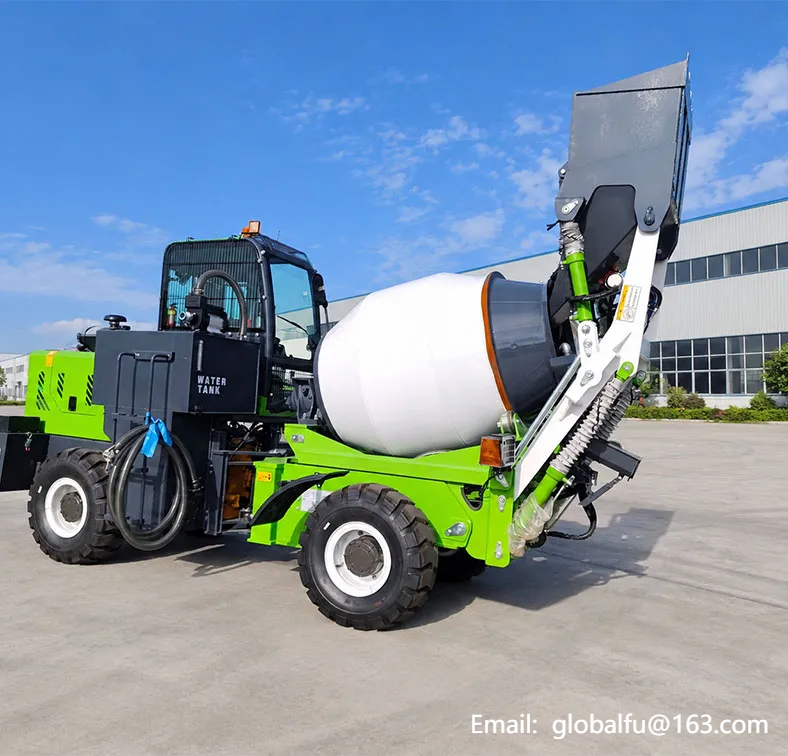
0.8 CBM Against Its Nearest Self Loading Concrete Mixer Capacity Options
When selecting a self loading concrete mixer, buyers usually compare different capacity options rather than only searching by yard measurement.
Kaishun offers multiple capacity configurations to match different project requirements.
| Specification |
0.5 CBM |
0.8 CBM |
1.2 CBM |
| Approximate yard equivalent |
~0.65 yd³ |
~1.05 yd³ |
~1.57 yd³ |
| Drive configuration |
4×4 |
4×4 |
4×4 |
| Drum rotation |
270° / 290° |
270° / 290° |
270° / 290° |
| Typical application |
Small construction tasks |
General construction projects |
Higher-volume projects |
| Material handling |
Integrated loading |
Integrated loading |
Integrated loading |
| Best fit |
Smaller batches |
Around 1 yard requirement |
Larger daily output demand |
For customers searching for a self loading concrete mixer for sale, the 0.8 CBM model often represents a practical middle option.
It is large enough to replace many small concrete mixer applications while remaining more compact than larger industrial concrete mixer solutions.
However, selecting the right machine depends on:
- Daily concrete demand
- Distance between loading and pouring points
- Available operators
- Ground conditions
- Project duration
- Required mobility
Capacity alone should not determine the final purchase decision.
Why a Self Loading Concrete Mixer Is Different From a Traditional Concrete Mixer Machine
The biggest difference between a traditional concrete mixer and a self loading concrete mixer truck is the workflow.
A conventional drum mixer mainly performs one task:
Mixing concrete.
A self loading mixer performs several tasks:
Loading + weighing + mixing + transporting + discharging.
For a small repair project, a basic cement mixer may be enough.
For a larger construction project, the buyer may need a complete construction concrete mixer solution that reduces dependency on additional equipment.
For example:
A traditional mixer may require:
- One person operating the mixer
- Workers loading aggregate
- Workers moving concrete by wheelbarrow
- Additional equipment for material handling
A self loading concrete mixer can reduce this process to:
- One trained operator
- One integrated machine
- One continuous production cycle
This is especially valuable where labor availability is limited or where the site is far away from ready-mix suppliers.
Kaishun Machinery focuses on this type of B2B application. As a China-based construction machinery manufacturer, Kaishun supplies self-loading concrete mixers together with other project equipment, including wheel loaders, rough-terrain forklifts, telehandlers, generator sets, lowbed semi trailers, aerial work platforms, and prefab houses.
For EPC contractors, construction companies, rental companies, and equipment distributors, this integrated supply approach can simplify procurement and international shipping.
What Actually Reduces Nameplate Capacity to Real Concrete Output?
An important mistake in concrete mixer machine selection is assuming that drum volume equals daily production.
A mixer with a 0.8 CBM capacity does not automatically produce 0.8 cubic meters every few minutes.
The actual output depends on the complete working cycle.
A typical cycle includes:
- Driving to the material location
- Loading aggregate and cement
- Adding water
- Mixing time
- Driving to the pouring location
- Discharging concrete
- Returning for the next cycle
The actual shift output depends on:
- Stockpile distance
- Pouring distance
- Ground conditions
- Operator experience
- Weather
- Fuel availability
- Project organization
This is why experienced buyers evaluate self loading concrete mixer capacity together with operating conditions.
A machine working on a compact residential project may complete many short cycles.
The same machine working on a remote road project may spend more time traveling.
The nameplate capacity stays the same. The real productivity changes.
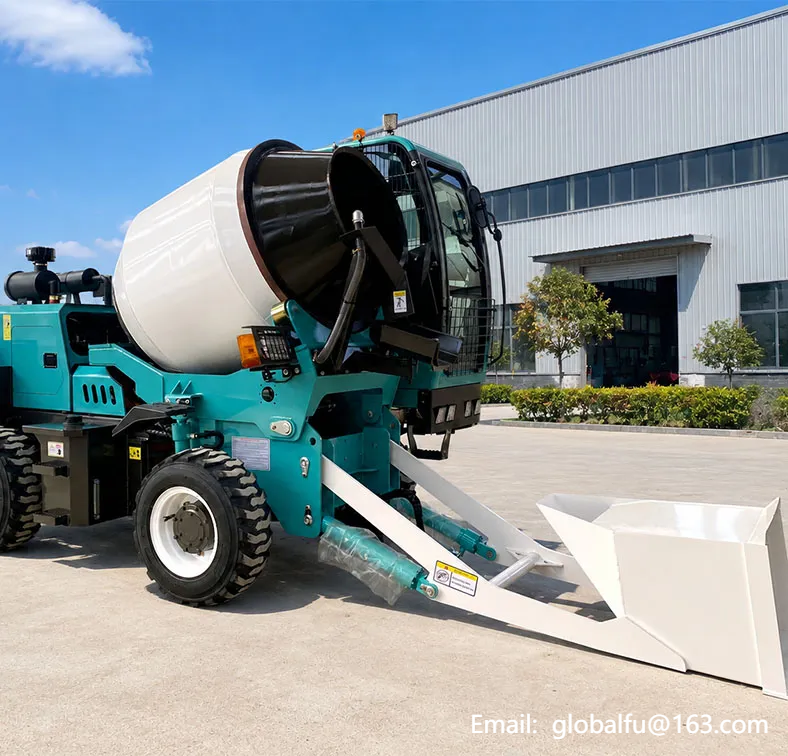
Why Labor Efficiency Matters More Than Drum Volume
Many buyers compare a concrete mixer for sale only by price and capacity.
However, labor cost can change the economics.
A towable mixer with a similar batch size may have a lower purchase price, but it usually depends on manual feeding.
The crew must move:
- Aggregate
- Cement
- Water
- Mixed concrete
A self loading concrete mixer reduces these manual steps through integrated operation.
For international construction companies, the question becomes:
“Do we need only a mixer, or do we need a complete concrete production solution?”
If a project already owns loaders and has enough workers, a traditional mixer may remain practical.
But if the project needs:
- Independent concrete production
- Reduced labor dependency
- Better mobility
- Remote operation capability
- Faster site deployment
then a self loading concrete mixer may provide stronger long-term value.
Where This Stops Making Sense Below 1 CBM
While a self loading concrete mixer provides significant advantages in mobility and labor efficiency, it is not automatically the best choice for every project below 1 cubic meter.
This is an important consideration for buyers searching for a small concrete mixer, 1 yard concrete mixer, or compact concrete mixer machine.
A traditional towable drum mixer with a similar batch volume may have a much lower initial purchase price. For a small contractor who already owns loading equipment, has sufficient workers, and only needs occasional concrete production, a basic mixer may still be the more economical solution.
The value of a self loading concrete mixer becomes clearer when the project has one or more of these conditions:
- No separate loader is available
- Labor costs are increasing
- The job site is remote
- Concrete supply from a batching plant is difficult
- The machine needs to move frequently
- Multiple small pours are required every day
The comparison is therefore not simply:
Self loading concrete mixer price vs. traditional mixer price
The better comparison is:
Complete project cost vs. equipment purchase cost
A lower-cost mixer may still require:
- Additional workers
- Material handling equipment
- More manual transportation
- Longer preparation time
- More site coordination
A self loading concrete mixer machine has a higher equipment investment because it combines multiple functions into one unit.
For contractors, EPC companies, mining projects, and infrastructure contractors, the calculation should include productivity, labor savings, mobility, and equipment utilization.
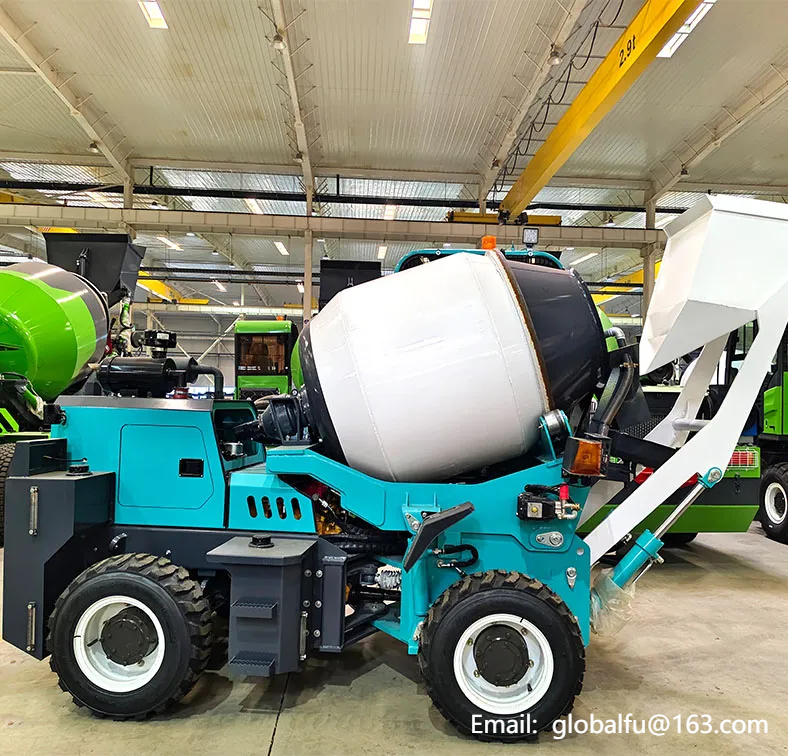
How Does a 0.8 CBM Self Loading Concrete Mixer Compare With a Traditional 1 Yard Mixer?
The phrase 1 yard concrete mixer usually represents a capacity search rather than a specific machine type.
A buyer may actually be comparing several different categories:
| Equipment Type |
Main Function |
Labor Requirement |
Mobility |
| Towable drum mixer |
Mixing only |
More manual labor |
Limited |
| Portable concrete mixer |
Small batch production |
Manual loading |
Easy transport |
| Stationary mixer |
Fixed production |
Requires material supply system |
Low mobility |
| Self loading concrete mixer |
Loading + mixing + transport |
Single operator |
High mobility |
A 1 cubic yard concrete mixer and a 0.8 CBM self loading mixer may appear similar when comparing only volume.
However, the production method is different.
A traditional mixer depends on external preparation.
A self loading mixer creates a mobile concrete production station.
This difference becomes important on:
- Rural construction projects
- Highway and road projects
- Mining areas
- Remote infrastructure projects
- Agricultural construction
- Utility projects
For these applications, reducing dependence on external equipment can directly improve project efficiency.
A Short Checklist Before Selecting a Concrete Mixer Machine at This Capacity
Before purchasing a concrete mixer machine, buyers should confirm the following points.
1. Confirm Required Batch Capacity
Do not compare only:
Convert the requirement into actual project demand.
Ask:
- How many cubic meters of concrete are required per day?
- How many pours are needed?
- How far must concrete travel?
A 0.8 CBM mixer may be ideal for one project but insufficient for another.
2. Evaluate Complete Workflow
A mixer is part of a production process.
Review:
- Material loading
- Mixing
- Transportation
- Discharge
- Cleaning
- Maintenance
A machine that reduces steps may provide more value than one with slightly larger capacity.
3. Confirm Engine and Technical Specifications
Engine configuration should always be confirmed directly with the supplier.
For example, Kaishun’s smaller models have published engine information, but specifications for different capacity models may vary.
When requesting a quotation, buyers should confirm:
- Engine brand
- Engine power
- Fuel consumption
- Hydraulic system
- Drum capacity
- Mixing output
- Warranty terms
Do not assume specifications transfer from one model to another.
4. Consider Site Conditions
A construction site is not always a flat factory floor.
Consider:
- Muddy terrain
- Uneven roads
- Long travel distance
- Limited access
- Remote location
A 4×4 self loading concrete mixer provides mobility advantages compared with many stationary or towable solutions.
5. Compare Total Ownership Cost
A professional buyer should evaluate:
- Purchase cost
- Fuel consumption
- Maintenance requirements
- Spare parts availability
- Operator requirements
- Expected working hours
- Resale value
The lowest purchase price does not always represent the lowest project cost.
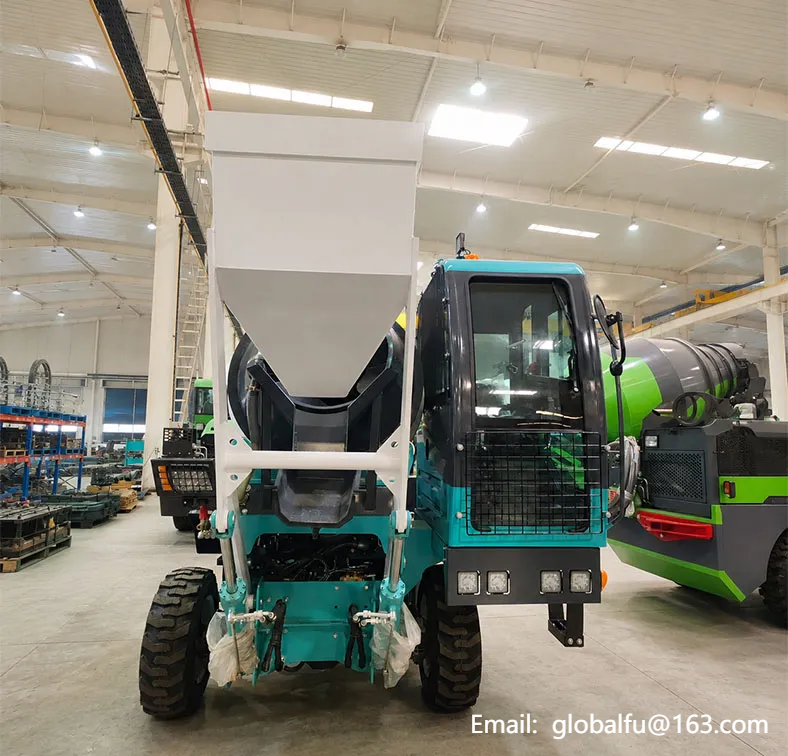
What Makes Kaishun a Reliable Concrete Mixer Machine Manufacturer?
For international buyers, selecting a concrete mixer machine manufacturer is not only about finding equipment.
It is about finding a supplier capable of supporting the entire project lifecycle.
Kaishun Machinery focuses on global B2B construction equipment supply.
Our customers include:
- Construction contractors
- EPC companies
- Infrastructure developers
- Mining project operators
- Equipment distributors
- Rental companies
- Private-label partners
Instead of supplying only one machine, Kaishun provides integrated equipment solutions.
The product range includes:
This allows customers to combine multiple equipment categories into one procurement plan.
For example, a remote construction project may require:
- A self loading concrete mixer for concrete production
- A generator set for temporary power
- A wheel loader for material handling
- A lowbed semi trailer for equipment transport
- A prefab house for site accommodation
Managing these through one supplier can simplify:
- Technical communication
- Export documentation
- Shipping coordination
- Spare parts planning
- After-sales support
Why Choose a China Concrete Mixer Manufacturer for International Projects?
Many international buyers compare local equipment suppliers with Chinese manufacturers.
A professional China construction machinery manufacturer can provide advantages such as:
Manufacturing Flexibility
OEM and ODM customization allows buyers to request:
- Branding
- Color changes
- Configuration adjustments
- Market-specific requirements
- Export Experience
International projects require more than production.
They also require:
- Export packaging
- Shipping coordination
- Documentation support
- Spare parts preparation
- Equipment Integration
Large projects rarely need only one machine.
A supplier with multiple equipment categories can provide a more complete solution.
For distributors and importers, this can also support product expansion.
Request a Quote for the Right Self Loading Concrete Mixer
Choosing between a 1 yard concrete mixer, portable mixer, and self loading concrete mixer requires understanding the real project requirement.
Capacity is important.
But capacity is only one part of the decision.
A complete evaluation should include:
- Required output
- Site conditions
- Labor availability
- Material loading method
- Transportation distance
- Equipment combination
- Long-term operating cost
Kaishun Machinery helps global contractors, distributors, and engineering companies select suitable construction equipment based on real project conditions.
When requesting a quotation, provide:
- Project location
- Required concrete output
- Preferred capacity
- Working environment
- Daily operating hours
- Required equipment list
- Customization requirements
Our engineering team can help recommend a suitable self loading concrete mixer, provide technical specifications, and develop a complete equipment solution.
Frequently Asked Questions
Is a 1 yard concrete mixer equal to a 0.8 CBM self loading concrete mixer?
Not exactly. One cubic yard equals approximately 0.7646 cubic meters. A 0.8 CBM self loading concrete mixer is slightly larger than a 1 yard concrete mixer in theoretical volume.
However, actual productivity depends on loading, mixing, transportation, and discharge cycle time.
What is the advantage of a self loading concrete mixer?
The main advantage is integration.
A self loading concrete mixer combines material loading, mixing, transportation, and discharge into one machine.
This reduces dependence on separate loaders and additional workers, especially on remote construction sites.
Is a self loading concrete mixer suitable for small construction projects?
It depends on the project conditions.
For occasional small jobs, a portable concrete mixer may be more economical.
For projects requiring frequent concrete production, remote operation, or reduced labor dependency, a self loading concrete mixer can provide better overall value.
How much does a self loading concrete mixer cost?
The price depends on:
- Capacity
- Engine configuration
- Hydraulic system
- Drive system
- Customization
- Destination country
- Shipping requirements
Kaishun does not publish a fixed price list because each project configuration can be different.
Buyers should request a quotation based on actual requirements.
Can one operator run a self loading concrete mixer?
Yes. One of the main advantages of a self loading concrete mixer is that one trained operator can complete loading, mixing, transporting, and discharge operations.
However, proper training and understanding of the machine manual remain essential.
What information should I provide when buying a concrete mixer machine?
Provide:
- Project location
- Required concrete volume
- Working conditions
- Aggregate type
- Required mobility
- Daily operating hours
- Preferred capacity
- Shipping destination
This allows the supplier to recommend the most suitable configuration.
Final Thoughts
A 1 yard concrete mixer search does not always mean the buyer needs a traditional one-yard drum mixer.
The real question is:
What equipment solution can produce concrete efficiently at the job site?
For some users, a small mixer is enough.
For contractors working in remote areas, infrastructure projects, mining environments, and large construction sites, a self loading concrete mixer machine can provide a stronger combination of mobility, productivity, and independence.
Kaishun Machinery supports global construction companies with not only concrete equipment but complete project equipment solutions.
From self loading concrete mixers to generators, loaders, lifting equipment, trailers, and prefab site facilities, Kaishun helps international customers simplify equipment sourcing and build reliable project operations.
Contact Kaishun Machinery to discuss your concrete production requirements and receive a customized equipment recommendation.











 September 02, 2026