Kaishun Engineering Team | Technical Content, Qingdao Kaishun Imp & Exp Co., Ltd. | Published: 21 August 2026
Equipment descriptions below reflect general category practice as of August 2026. Kaishun catalog parameters are given only for self-loading mixers, the type Kaishun manufactures.
Concrete mixers are usually classified by drum shape. A more useful sort is by how concrete gets from the mixing point to the pour, because that route decides crew size, daily output and which types your site rules out. Six types cover almost every job.
Each entry below gives typical output, the crew it needs, and the condition under which it stops being the right answer.
1. Batch drum mixer (tilting and non-tilting)
The small rotating drum on a frame, often on two wheels, found on almost every small site in the world.
- Typical output: roughly 0.1 to 0.5 m³ per batch, commonly a few cubic metres per day in practice
- Crew: two to four people. One or two loading, one operating, one or two moving concrete in barrows or buckets
- Concrete reaches the pour by: human muscle, over short distances
- Ruled out when: the pour is more than about 30 metres from the mixer, or the daily requirement passes what a barrow crew can physically move. Beyond that the mixer stops being the bottleneck and the labour does.
The tilting variant discharges by tipping the drum, which handles stiffer mixes and larger aggregate better than the non-tilting type that relies on internal blades to push concrete out. If your mix is dry and stiff, that distinction matters more than the capacity figure.
Cheap to buy, cheap to move, and honest about what it is. The cost is entirely in labour, and on a market where labour is expensive that cost is not small.
2. Pan and forced-action mixer
A stationary pan with blades or paddles driven through the material rather than tumbling it. Precast yards, block plants and laboratories use these.
- Typical output: varies widely by size, from laboratory batches to several cubic metres per batch in production plants
- Crew: one operator, plus material feed, usually within a fixed plant layout
- Concrete reaches the pour by: discharge directly into moulds, skips or a conveyor immediately below
- Ruled out when: the concrete has to travel anywhere at all. This is a fixed-position machine feeding a fixed-position process.
Forced action gives more uniform mixing than gravity tumbling, which is why it dominates where mix consistency is measured rather than assumed: coloured concrete, fibre-reinforced mixes, precast elements with tight strength tolerances, and anything with a low water-cement ratio that a gravity drum simply will not homogenise.
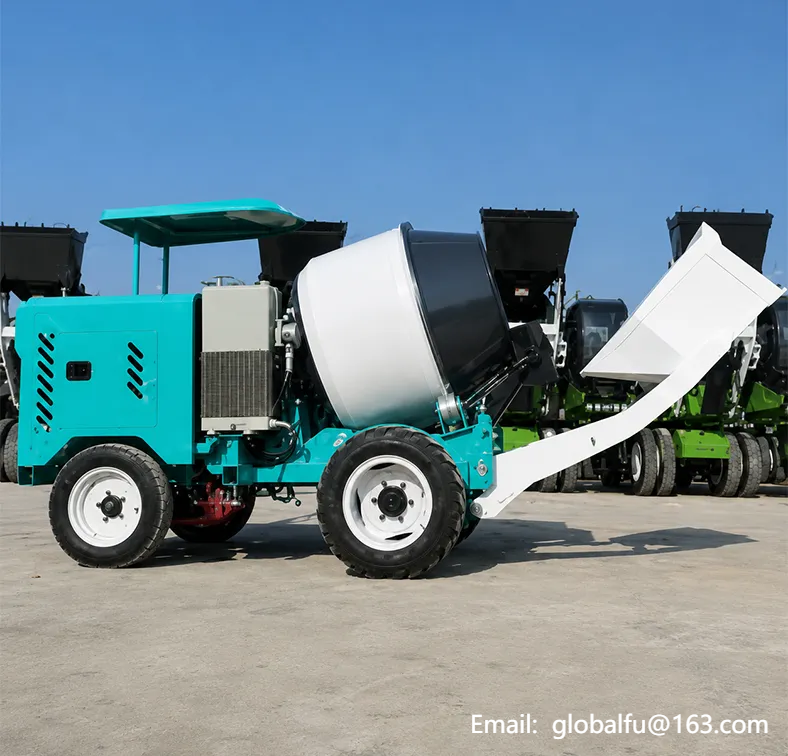
3. Transit mixer truck
The rotating-drum truck that carries concrete from a batching plant to site.
- Typical output: commonly 6 to 12 m³ per load, varying by market and axle regulations
- Crew: one driver, plus whatever placing crew or pump the site has
- Concrete reaches the pour by: road, from a plant that may be many kilometres away
- Ruled out when: there is no batching plant within economic haul distance, when site access will not take a loaded truck, or when the pour schedule cannot be predicted reliably enough to book deliveries
The economics are strong where a plant network exists, because you buy concrete rather than owning production. The dependency is the point of failure: a delivery that arrives late meets a crew standing idle, and one that arrives during a traffic delay may arrive outside its workable window. Contractors in regions with thin plant coverage learn this before they learn anything else about concrete supply.
Note that these are haulage units, not mixers in the production sense. The drum keeps concrete agitated in transit; the batching happened at the plant.
4. Volumetric mixer
A truck carrying separate compartments of cement, aggregate and water, metering and mixing continuously at the point of discharge.
- Typical output: continuous production while material remains on board
- Crew: one to two, one of whom is controlling the mix
- Concrete reaches the pour by: road to site, then mixed on demand at the discharge point
- Ruled out when: the work is a single large continuous pour where a plant and truck fleet is simply faster, or where the operating market has no supply chain for the machine’s calibration and servicing
The distinguishing capability is that no concrete is batched until it is needed, so nothing goes off if the pour stops, and mix design can change between loads without waste. That matters for repair work, small dispersed pours and jobs where the required quantity is genuinely unknown at the start of the day. Against that, calibration discipline is a permanent operational responsibility rather than a commissioning task.
5. Stationary batching plant
Fixed silos, aggregate bins, weighing systems and a mixer, feeding transit trucks or a pump.
- Typical output: the highest of any type here, sustained, from tens to hundreds of cubic metres per hour depending on plant size
- Crew: plant operator, loader driver for the stockpiles, laboratory or QC staff where the specification requires it, plus the transport fleet
- Concrete reaches the pour by: transit trucks or pumps, from a fixed point
- Ruled out when: the project is short, dispersed, or does not have the volume to amortise installation, foundations, power supply and commissioning
Automated weighing and moisture compensation give the tightest, most documented batch consistency available, which is why large structural works and anything with a demanding testing regime end up here. The commitment is real: this is an installation with a lead time and a site footprint, not a machine that arrives on a truck and starts working.
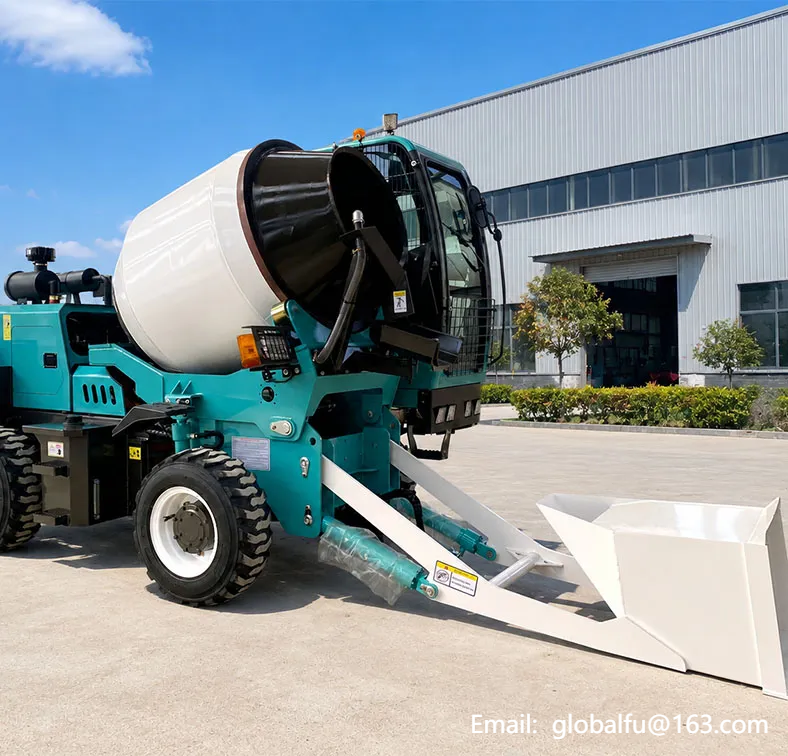
6. Self-loading concrete mixer
One machine that loads its own aggregate, weighs, mixes, travels and discharges. The type Kaishun manufactures, so this entry carries catalog parameters rather than general description.
- Output capacity: 0.32 / 0.5 / 0.8 / 1.2 / 1.8 / 2 / 3.5 / 3.8 / 4.0 CBM per batch
- Drive: 4×4 across the range
- Drum rotation: 270 or 290 degrees depending on model
- Rotary table: sealed worm-gear type, 5-year warranty
- Certification: IO 9001 quality management system, CE marking
- Crew: one operator, who is loading, batching, driving and discharging
- Concrete reaches the pour by: the mixer driving there itself
- Ruled out when: the requirement is a large sustained continuous pour, or where the specification demands automated moisture compensation and documented batch records that an operator-controlled machine cannot produce to the same standard
The reason this type exists is remoteness. Where no plant is within haul distance and no delivery schedule can be relied on, a machine that produces concrete at the place it is needed removes the entire supply dependency. It also replaces a loader, a mixer and a haul unit with one asset and one operator, which is why it appears wherever labour is scarce or expensive.
The trade-off is worth stating plainly: batch consistency depends on the operator and on stockpile discipline. Damp aggregate that nobody accounts for changes water content across every batch that day.
The mistake that costs the most: sizing on drum volume
Buyers across all six types make the same error. They compare drum capacity and assume the larger number produces proportionally more concrete per day.
Drum volume sets the size of one batch. Daily output is set by how many complete cycles finish in a shift, and a cycle includes travel, loading, waiting and discharge. On a constrained site with a long haul route and one turning area, a larger machine can place less concrete per day than a smaller one, because it spends the shift manoeuvring.
The same arithmetic applies to transit trucks: a 10 m³ truck on a 40-minute round trip delivers less per day than a 7 m³ truck on a 15-minute round trip. Batching wait time at the plant belongs in that calculation too, and it is routinely left out.
Work out your cycle time before you compare capacities:
Daily output = batch or load size x 60 / cycle time in minutes x productive hours
Then check the answer against two limits outside the equipment entirely. Material delivery to the site may cap production below what any of these machines could produce, and the crew placing and finishing the concrete has its own ceiling. Size to the tightest of the three.
Picking between them
Most category guides classify by mechanism and stop, leaving the reader to work out which type survives their actual constraint. This is that step.
| Your situation |
The type that fits |
| Batching plant nearby, predictable schedule, good access |
Transit mixer truck |
| No plant within haul distance, dispersed small-to-medium pours |
Self-loading mixer |
| Large sustained pours, long project, demanding QC regime |
Stationary batching plant |
| Quantity unknown, frequent mix changes, repair work |
Volumetric mixer |
| Fixed production of precast or block products |
Pan / forced-action mixer |
| Small pours, short carry distance, low daily volume |
Batch drum mixer |
| Remote site, one operator available, also needs material handling |
Self-loading mixer |
Two situations resist a single answer. A remote project with one large structural pour and many small ones often justifies both a self-loading mixer for the routine work and hired plant capacity for the critical pour. And a site with hardstanding access but no reliable plant schedule sits between the transit truck and the self-loading options, where the decision turns on how much idle crew time a late delivery actually costs you.
FAQ
Q: What is the difference between a self-loading mixer and a transit mixer truck?
A: A self-loading mixer produces concrete, loading its own aggregate and batching on site. A transit mixer truck transports concrete that was batched at a plant. One removes the supply dependency; the other depends on it entirely.
Q: Which type gives the most consistent concrete?
A: A stationary batching plant, because weighing is automated and moisture compensation is built in. Pan mixers give the most uniform mixing action for a given batch. Machines where an operator controls the water are consistent to the standard of that operator’s discipline.
Q: What sizes do Kaishun self-loading mixers come in?
A: Output capacity from 0.32 to 4.0 CBM, across nine listed capacities. Some category copy quotes a higher ceiling; treat 4.0 CBM as the maximum until confirmed in writing.
Q: Does Kaishun supply batching plants or transit mixer trucks?
A: No. Kaishun manufactures self-loading concrete mixers. The other types in this article are described for comparison and are not part of the product range.
Q: How many people does each type need?
A: A batch drum mixer needs a small crew, mostly for moving concrete. A self-loading mixer needs one operator. A transit truck needs a driver plus your placing crew. A batching plant needs an operating team plus the transport fleet.
Q: What does a self-loading mixer cost?
A: No price range is published. Pricing is quotation-based and depends on capacity, engine and emissions tier, and destination. Send a defined specification for a written quotation.
Q: Can one type handle everything?
A: No. The six types exist because site conditions differ. Contractors working across varied conditions frequently own one type and hire another for the jobs it does not suit.
Next step
Before shortlisting a machine, write down three things: your peak daily concrete requirement, the distance and surface between your material stockpile or plant and the pour point, and how many people you can put on concrete work. Those three answers eliminate most of this list before any supplier is contacted.
About the author
This article was prepared by the Kaishun Engineering Team at Qingdao Kaishun Imp & Exp Co., Ltd., a direct-factory manufacturer of construction machinery across nine equipment categories, with 20+ years in export manufacturing and 100+ invention and utility model patents. Aftersales coverage runs to 150+ service agencies and 10+ overseas spare parts centres, with a 1-year or 2,000-hour warranty and lifetime online technical support. For load charts or a written quotation: +86 176 8575 5030 (WhatsApp / WeChat) or Contact this email: [email protected]. Enquiries answered within 24 hours.











 August 21, 2026