Choosing the wrong aerial work platform can mean wasted rental costs, limited reach, poor jobsite access, or serious safety risks. With so many boom, scissor, mast, and truck-mounted options available, buyers can easily overbuy or choose the wrong machine. The solution is to match the working platform to the real job.
An aerial work platform, often called an AWP or mobile elevating work platform, is equipment designed to lift workers, tools, and light materials to elevated work areas. The right type depends on platform height, horizontal reach, work area conditions, load capacity, mobility, and whether the task involves indoor work, rough terrain, construction, installation, or maintenance.
What Is an Aerial Work Platform and How Does It Work?
An aerial work platform is a type of lift equipment used to provide temporary access to elevated work areas. Depending on the design, the working platform may travel mainly vertically, extend outward on a boom, articulate around obstacles, or operate from a truck chassis. OSHA describes vehicle-mounted aerial lifts as devices used to elevate personnel and includes extendable boom platforms, articulating boom platforms, aerial ladders, and vertical towers.
You will also see terms such as aerial lift, AWP, elevated work platform, mobile elevated work platforms, mobile elevating work platform, and access platforms. The terminology can overlap in everyday purchasing discussions, but not every type of aerial equipment works in the same way. OSHA, for example, discusses scissor lifts separately because their crossed-beam mechanism raises the platform primarily straight up and down.
The major parts of an aerial machine normally include the chassis or base, lifting structure, controls, hydraulic or electrical system, and working platform. Depending on the design, other parts of an aerial lift may include outriggers, stabilizers, guardrails, boom sections, emergency controls, and leveling systems. Each part of an aerial platform contributes to reach, stability, control, or operator protection.
What Are the Main Types of Aerial Work Platforms?
There is no single type of aerial work platform that fits every project. The main types of aerial work equipment are chosen according to reach direction, site conditions, platform size, mobility, and task. Buyers often compare a boom lift, scissor lift, mast lift, vertical lift, and truck-mounted aerial work platform when planning elevated work.
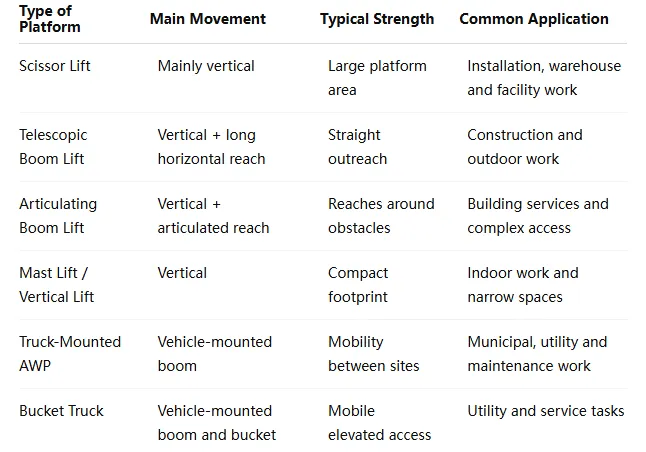
These are among the most common types of AWPs, but specifications vary widely. A compact mast lift designed for smooth indoor floors should not be treated as an alternative to a rough-terrain boom lift. Likewise, a large working platform on a scissor machine serves a different need from the narrow basket at the end of a telescopic boom.
Modern ANSI A92 standards use the broader MEWP framework for equipment intended to position personnel, tools, and materials at elevated work locations. For international buyers, however, local regulations and terminology should always be checked in the destination market.
Boom Lift vs. Scissor Lift: Which Working Platform Is Right?
The boom lift and scissor lift are two of the best-known types of construction lifts, but their movement patterns are very different.
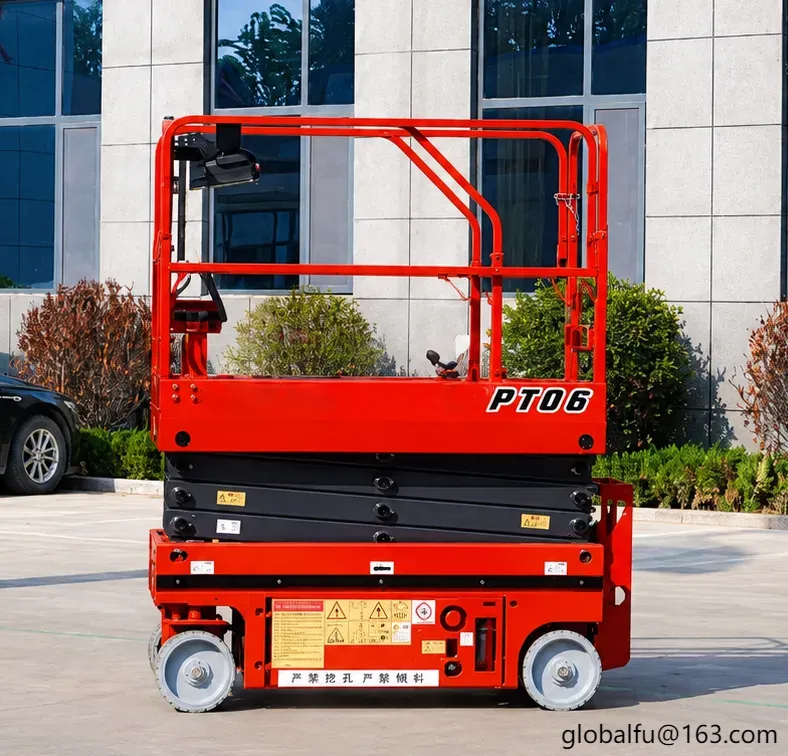
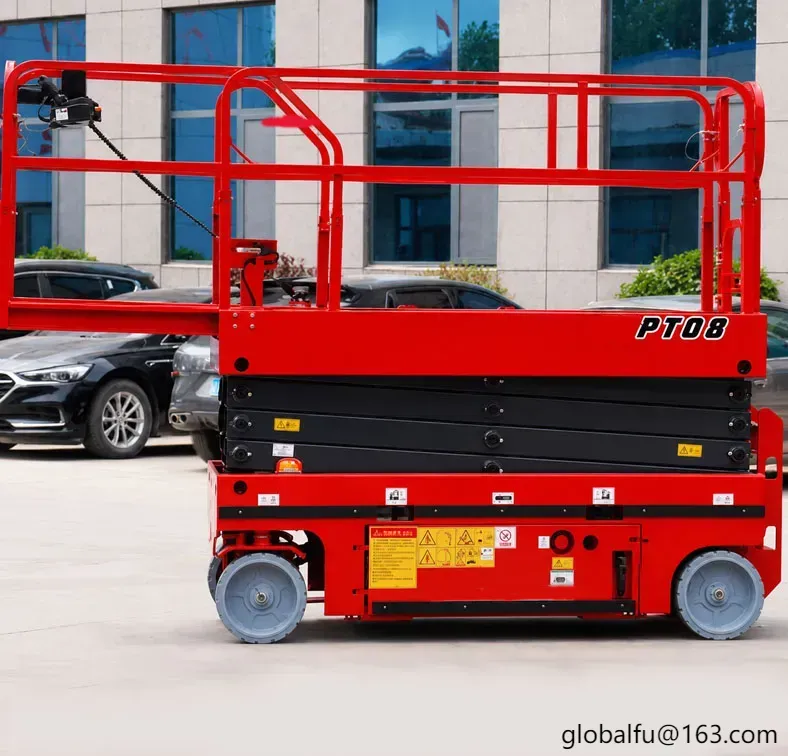
A scissor lift raises its working platform mainly straight upward. The crossed lifting structure provides a relatively large platform area, which can be useful when several workers, tools, or materials must stay together. A scissor machine often works well for ceiling installation, lighting, warehouse maintenance, manufacturing facilities, and other jobs where the crew needs vertical access directly below the work area. OSHA classifies scissor lifts separately from aerial lifts under its guidance and stresses firm, level surfaces, equipment stability, traffic control, and safe positioning.
A boom lift, by contrast, gives the operator both height and horizontal outreach. An articulated platform can move around obstacles, while a straight telescopic boom is often chosen when long outreach is the main requirement. This makes boom-supported aerial platform equipment useful for façade work, structural installation, industrial maintenance, and outdoor projects where workers cannot position the base directly below the target.
Simple selection rule:
Choose a scissor lift when you mainly need vertical elevation and a larger working platform.
Choose a boom lift when you need horizontal reach or must access a work area around an obstacle.
Choose a truck-mounted solution when road mobility between work sites is an important part of the project.
That simple distinction often makes choosing an aerial work platform much easier.
When Should You Choose a Telescopic Boom Lift?
A telescopic boom lift uses straight boom sections that extend outward, giving the machine strong horizontal reach as well as working height. Compared with an articulated boom lift, the boom path is simpler and is especially useful where the target is far from the machine but does not require the basket to bend around several obstacles.
You should consider a telescopic boom lift when construction crews need to reach steel structures, building façades, roofing zones, elevated mechanical systems, or other open work areas. A long telescopic boom is particularly useful for outdoor work where equipment can be positioned at a safe distance from the building or structure.
However, a telescopic boom lift is not automatically the right AWP because it offers greater reach. Before selecting the right aerial work equipment, check ground conditions, turning space, maximum working height, horizontal outreach, basket capacity, travel requirements, and surrounding hazards. More reach usually means a larger machine footprint and different stability requirements.
When Is a Truck-Mounted Aerial Work Platform the Better Choice?
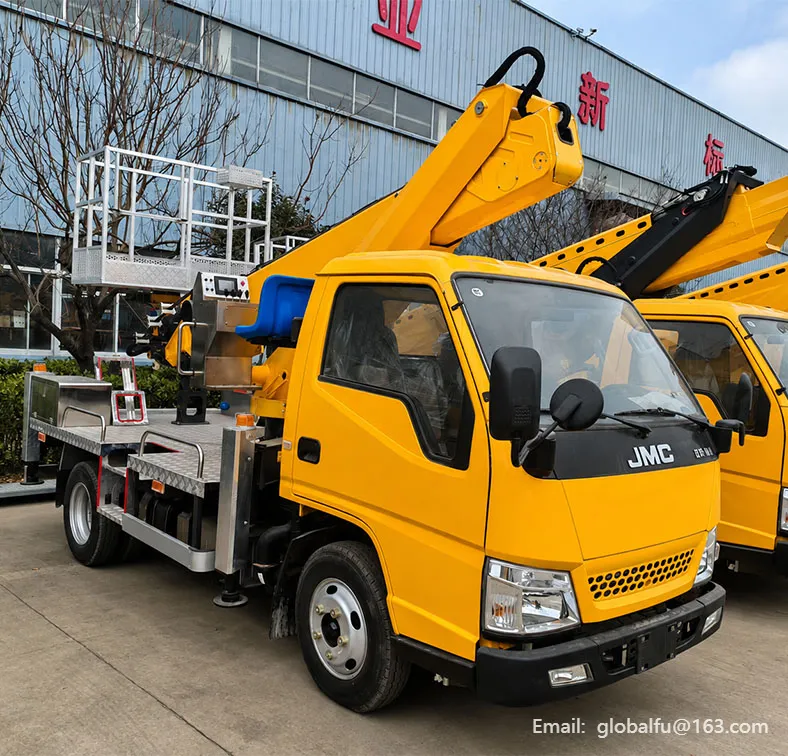
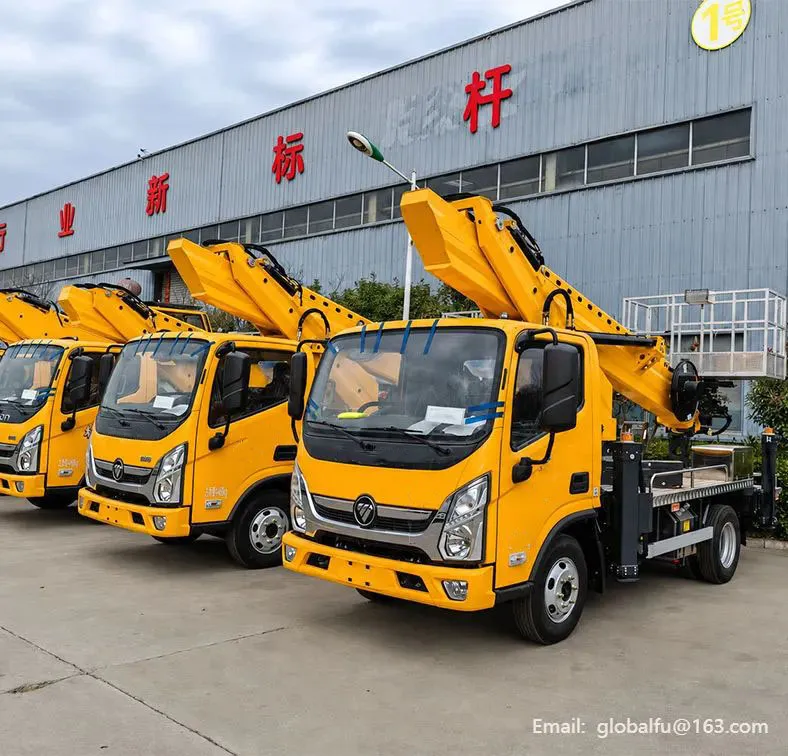
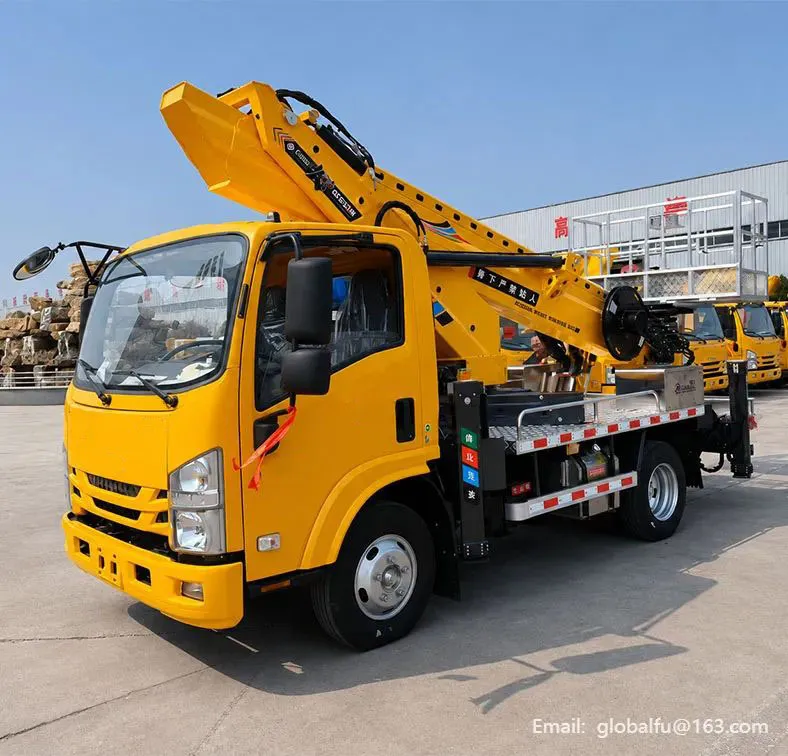
A truck-mounted aerial work platform combines a vehicle chassis with an elevated working platform and boom system. Unlike many self-propelled access machines that remain within one construction site, a truck-mounted unit can be useful when crews need to move between different streets, facilities, or project locations during the same working day.
Typical applications include:
- Streetlight maintenance
- Building façade service
- Municipal maintenance work
- Utility inspection
- Sign installation
- Infrastructure servicing
- Tree and roadside work
- Emergency repair
- Electrical work where the approved machine configuration is suitable
- Other maintenance and construction work
A bucket truck is another familiar vehicle-mounted aerial device. The exact design and regulatory classification depend on the machine and market, so buyers should not treat every bucket truck, aerial platform truck, and truck-mounted boom as identical.
For Kaishun Machinery’s international B2B customers, truck-mounted solutions can be particularly attractive where mobility matters as much as platform height. Contractors, municipal project buyers, distributors, and rental companies may need a working platform that can finish one task, retract, travel, and begin another job without separate transport equipment.
How Do You Choose the Right Aerial Work Platform for a Job?
Selecting an aerial work platform should begin with the job, not with a catalog model. We normally advise buyers to define the work area first and then identify the machine configuration that can reach it safely and efficiently.
Start with these questions:
- What is the required platform height?
- Is horizontal outreach necessary?
- Does the working platform need to carry one worker or several?
- How much equipment or material will be carried?
- Is the machine for indoor work or outdoor work?
- Is the surface smooth, paved, uneven, or rough?
- Does the machine need to travel between job sites?
- Are there overhead structures or power lines?
- Is a compact machine required for narrow access?
- Will the equipment perform installation work, inspection, cleaning, electrical service, or maintenance work?
The right aerial work platform is the machine that meets these real conditions without adding unnecessary size, reach, or cost. A small vertical lift may be ideal inside a warehouse, while a boom lift may be essential for structural work. A scissor lift can provide a stable platform with a broad deck, but it cannot replace the outreach of a boom.
When considering an AWP, also look beyond nominal height. Platform extensions, basket load, chassis dimensions, turning radius, stabilization method, control system, transport size, and local service support can all affect productivity. Choosing the right aerial work machine means balancing reach, access, safety, transportation, and total project cost.
Which Safety Features Matter Most on an Aerial Lift?
The most useful safety features are the ones that address the real hazards of the job. OSHA lists falls, falling objects, tip-overs, platform ejection, structural failure, electrical shock, entanglement, and contact with overhead objects among important aerial lift hazards.
Depending on the type of platform, useful safety systems may include guardrails, emergency lowering, emergency stop controls, outriggers or stabilizers, leveling systems, interlocks, load monitoring, warning devices, and clearly marked operating controls. The exact configuration should be checked against the machine specification and applicable local standards rather than assumed from the product category alone.
Operators also need to inspect the work area. OSHA advises checking for holes, unstable surfaces, slopes, debris, overhead objects, nearby traffic, severe weather, and electrical lines. Its U.S. guidance instructs workers to treat overhead power lines and communication cables as energized and maintain at least 10 ft (3 m) clearance unless appropriate measures have been taken.
Searches sometimes simplify the issue into phrases such as “aerial lift fatalities are falls” or ask about the major causes of aerial lift fatalities. That framing is too narrow. Falls are important, but OSHA’s hazard list also includes electrocution, tip-over, ejection, structural failure, and other hazards.
What Should an Aerial Platform Safety Program Include?
Good platform safety requires more than buying equipment with modern controls. Employers must also manage training, inspections, operating procedures, jobsite hazards, and maintenance.
For U.S. workplaces, OSHA says only trained and authorized personnel should operate aerial lifts. Training should cover electrical hazards, fall hazards, unsafe conditions, correct machine operation, load limits, inspection requirements, and manufacturer instructions. Retraining may also be necessary when accidents occur, workplace hazards change, or operators demonstrate unsafe use.
A practical aerial platform safety program should therefore address:
- Pre-use equipment inspections
- Work-zone hazard assessment
- Manufacturer operating instructions
- Load and platform limits
- Emergency procedures
- Fall-protection requirements where applicable
- Stabilizer and outrigger setup
- Wind and weather limits
- Electrical hazards
- Traffic control
- Operator authorization
- Platform training
- Maintenance records
This is the foundation for the safe use of aerial lifts. A trained operator must understand not only how to operate the platform, but also when not to use an aerial platform.
For example, OSHA’s scissor-lift guidance highlights stability, wind, level surfaces, nearby traffic, overhead structures, and energized electrical lines. Safe practices can differ between a scissor lift and a boom lift, so a generic training session should not replace machine-specific instruction.
How Do Platform Height, Size, Reach, and Jobsite Conditions Affect Selection?
Many buyers start with one number: maximum platform height. That is important, but it is only one part of the selection process.
A taller working platform does not help if the machine cannot reach the actual target horizontally. Likewise, a long telescopic boom may add unnecessary complexity when the job simply requires vertical access. The best equipment choice considers both vertical and horizontal geometry.
Key Selection Factors
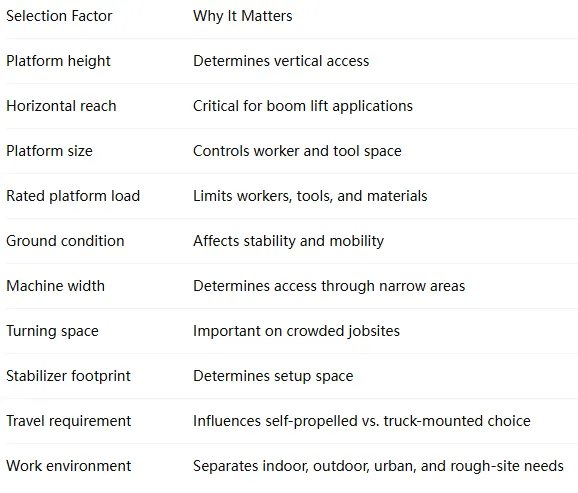
A large platform or large platform area can improve productivity for installation teams, but it also affects machine dimensions and load. A mast lift or vertical lift may be better where access is narrow and the job requires one technician with light tools.
The same principle applies to different types of elevated work. Instead of asking only, “How high can this machine go?”, ask, “How does my crew need to access the target working platform position?” That question usually leads to a more accurate equipment choice.
How Should B2B Buyers Compare Aerial Work Platform Manufacturers?
Price matters, but international B2B buyers should compare platform manufacturers on more than the purchase price of the machine.
A construction contractor, distributor, importer, or equipment rental company should evaluate:
- Product configuration
- Manufacturing quality
- Maximum working height
- Outreach
- Rated load
- Safety systems
- Hydraulic and control components
- Customization options
- Export packaging
- Technical documentation
- Spare parts
- Warranty terms
- After-sales support
- Shipping coordination
- Availability of related construction machinery
At Kaishun Machinery, we serve overseas engineering and construction buyers rather than treating each machine as an isolated sale. Our broader equipment range includes self-loading concrete mixers, wheel loaders, rough-terrain forklifts, telehandlers, generator sets, lowbed semi-trailers, prefab houses, and aerial work platforms.
That matters when a contractor needs more than one machine for the same project. Instead of managing separate suppliers for every equipment category, buyers can discuss equipment integration, OEM/ODM requirements, consolidated shipping, spare parts, and project support through one sourcing channel.
For distributors and private-label partners, this approach can also simplify branding and product-line expansion. For EPC and remote-project buyers, it can reduce communication and logistics complexity.
If you are choosing an aerial work platform for a construction, municipal, rental, or infrastructure project, send us your required working height, horizontal reach, platform capacity, destination country, and jobsite conditions. Our team can help you compare the available configuration and prepare a project-based quotation.
Frequently Asked Questions About Aerial Work Platforms
What is the main use of an aerial work platform?
The main use of aerial work equipment is to provide workers with temporary access to elevated work areas for construction, installation, inspection, cleaning, repair, and maintenance. An aerial platform used for maintenance may be self-propelled or vehicle-mounted depending on the work location and mobility requirements.
What are the main types of aerial work platforms?
The main types of AWPs include boom lift equipment, scissor lift equipment, mast lifts, vertical lifts, and truck-mounted platforms. A telescopic boom provides long straight outreach, while an articulating boom can reach around obstacles. Scissor machines mainly provide vertical elevation and a larger working platform.
Is a scissor lift an aerial lift?
The terms are often grouped together in the access-equipment industry, especially under the broader MEWP category. However, OSHA’s U.S. guidance distinguishes a scissor lift from vehicle-mounted aerial lifts because the scissor mechanism raises the working platform vertically using crossed beams.
What is the difference between a boom lift and a scissor lift?
A boom lift can provide both vertical height and horizontal outreach, making it suitable for reaching over or around obstacles. A scissor lift mainly moves vertically and often provides a wider working platform for workers and tools. The correct choice depends on access geometry, site conditions, height, and load.
When should I consider a telescoping boom lift?
Consider a telescoping boom lift when the work point requires substantial horizontal reach and there is a relatively clear path between the machine and the elevated target. A telescopic boom lift is commonly considered for open construction areas, façade work, structural installation, and maintenance where straight outreach is useful.
How do I safely move a scissor lift?
Follow the machine manufacturer’s instructions and the applicable site safety rules. OSHA notes that safe scissor-lift use depends on equipment limitations, stable surfaces, traffic control, weather conditions, overhead hazards, and proper positioning. Manufacturer instructions often restrict moving an elevated machine under certain conditions, so the operator should never assume travel is safe simply because the controls allow it.
Final Thoughts: Selecting the Right Aerial Work Platform
This complete AWP guide comes down to one principle: start with the job, then choose the machine.
Do not select an aerial work platform only because it has the greatest platform height or because another contractor uses the same model. Define the work area, horizontal reach, ground conditions, basket capacity, mobility, safety requirements, and transport needs first.
A scissor lift may be excellent for vertical access and a broad working platform. A boom lift may be better when horizontal reach matters. A mast lift can solve compact indoor-access problems. A truck-mounted aerial work platform can be the stronger option when crews must travel between different sites.
For global construction projects, the purchasing decision also extends beyond the machine itself. Equipment reliability, customization, export coordination, spare parts, after-sales service, and the ability to combine several types of construction machinery into one procurement plan can directly affect project efficiency.
Need help selecting the right aerial work platform? Contact Kaishun Machinery with your required height, reach, platform load, project country, and application. We can help you evaluate the suitable AWP configuration and develop a one-stop equipment solution for your project.











 August 12, 2026