Kaishun Engineering Team | Published August 27, 2026
A self-loading mixer fails when a job needs more concrete per hour than one machine and one operator can produce. A transit mixer fleet fails when the nearest batching plant is too far away to keep trucks cycling before the load starts to set. Distance decides which failure you’re planning around.
The Variable That Actually Decides This
Most comparisons between these two approaches default to price per cubic meter or crew size, treated as fixed properties of the machine. They aren’t. Both numbers move depending on one thing: how far the job site sits from a working batching plant.
A transit mixer truck carries concrete that was already batched and mixed at a stationary plant, agitating the load in transit to keep it workable until pour. That setup assumes the plant exists, has capacity, and is close enough that the concrete arrives within its workable window — typically 90 minutes to two hours depending on mix design and site temperature. A self-loading mixer removes that dependency. It carries its own water tank, aggregate hopper, and weighing system, and batches concrete on-site, at the pour location, on demand.
Neither approach is better in the abstract. The question a contractor bidding remote infrastructure work actually needs answered is: what happens to my cost and my schedule if the plant is 40 km away instead of 4 km away?
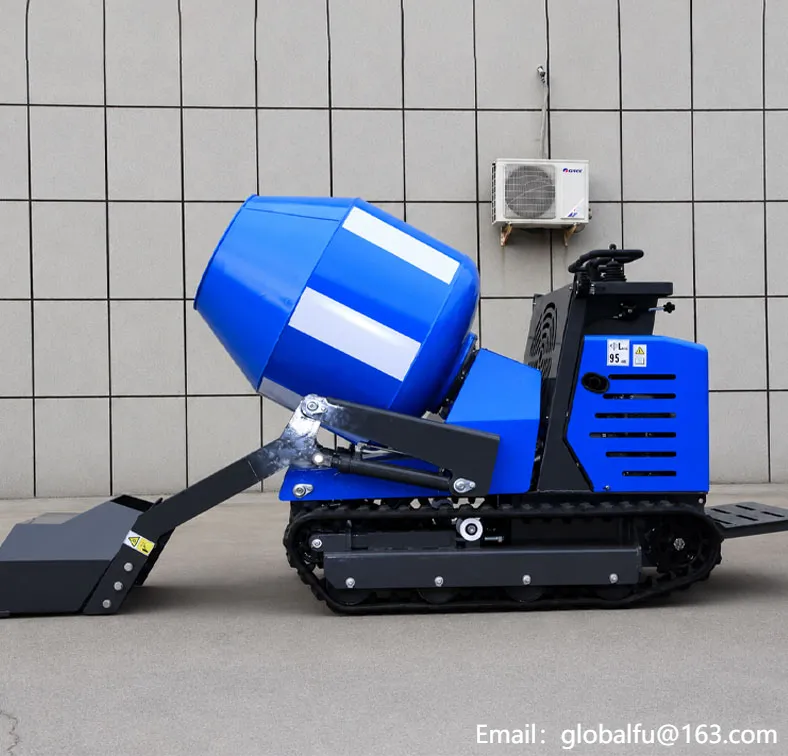
Self-Loading Mixer vs Transit Mixer Truck: Side-by-Side
| Factor |
Self-Loading Mixer |
Transit Mixer Truck (Fleet) |
| Concrete source dependency |
None — batches on-site from raw aggregate, cement, and water |
Fully dependent on a stationary batching plant |
| Crew count |
1 operator handles loading, mixing, transport, and discharge |
Plant crew plus one driver per truck, coordinated by a dispatcher |
| Output per shift |
Bounded by drum cycles — a 4.0 CBM unit run continuously covers roughly 15-25 CBM in an 8-hour shift depending on haul distance to the pour point |
Bounded by plant output and truck cycle time — a well-run fleet with a nearby plant can exceed 200 CBM per shift |
| Road access requirement |
4×4 drivetrain handles unpaved and rough terrain to the pour point itself |
Needs road access suitable for a loaded highway truck; poor terrain near the plant or site limits cycle speed |
| Cost exposure at 40 km from a plant |
Flat — machine cost and fuel are the same whether the site is 4 km or 40 km from the nearest town, because there’s no plant round-trip |
Rises directly with distance — every extra kilometer adds truck cycle time, reduces the number of loads deliverable per shift before the concrete window closes, and can force smaller pours or added trucks to compensate |
Where the Self-Loading Mixer Wins
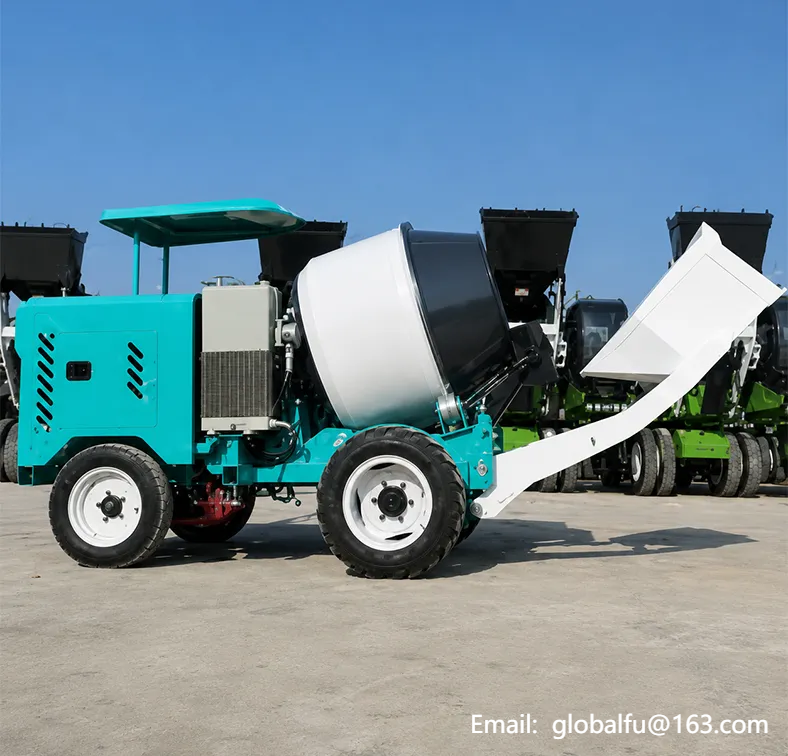
The self-loading mixer’s advantage isn’t raw output. It’s that its output doesn’t depend on infrastructure the contractor doesn’t control. On a site with no nearby batching plant — the situation this comparison is written for — a transit mixer fleet isn’t a cheaper alternative, it’s not an option at all without building or trucking in plant capacity first.
That changes the economics on jobs like rural road segments, remote power or water infrastructure, or sites accessible only by unpaved routes. A 4.0 CBM self-loading unit can be positioned at the pour location, mix a batch from raw materials carried or stockpiled on-site, and discharge directly into forms without a delivery window to manage. If the site moves — a road project advancing kilometer by kilometer, for instance — the mixer moves with it on its own 4×4 drivetrain rather than requiring the plant location to be renegotiated.
Kaishun’s global service network, including 150+ service agencies and overseas spare parts centers, also matters more on remote work than it does on an urban pour serviced by a plant down the street: parts and support have to reach the site, not the other way around.
Where the Transit Mixer Fleet Wins — Without Qualification
A self-loading unit cannot match a transit fleet’s volume on a large urban pour with a plant next door. This isn’t a close call. A single self-loading machine, however efficiently run, tops out at the output of one drum cycling repeatedly. A transit fleet’s output scales with how many trucks the contractor puts on the road, limited mainly by plant capacity and site access for simultaneous unloading. For a large-volume commercial pour where the batching plant is a short haul away, a transit fleet will out-produce any number of self-loading machines a contractor could reasonably mobilize for the same job.
There’s a second honest limitation worth stating plainly: a self-loading mixer’s batching accuracy depends on operator discipline. The machine weighs and proportions materials as instructed, but a transit-plant batch is produced under a fixed, plant-controlled process that doesn’t vary with who’s running it that day. An inconsistent operator on a self-loading unit — rushing the load sequence, misjudging aggregate moisture, skipping a weigh-check — can produce batch-to-batch variation that a certified plant process is built to avoid. That risk is manageable with training and a consistent loading procedure, but it’s a real variable a transit-sourced pour doesn’t carry.
The Misconception Worth Correcting
The common assumption is that “self-loading” means the machine removes the skill requirement along with the plant dependency. It doesn’t — it relocates the skill. A transit mixer driver doesn’t need to know batch proportions; the plant already handled that. A self-loading mixer operator does the batching, which means training and a repeatable loading sequence matter more here, not less, than on a transit-delivered job.
The edge case that trips up the cost comparison: on a small, short-duration pour close to an existing plant, mobilizing a self-loading unit at all can cost more in setup time than simply ordering two truckloads of ready-mix. Distance from the plant is the deciding variable in both directions — it’s what makes the self-loading machine the right call on a remote site, and what makes it the wrong call on a small job a plant could service directly.
3.5 CBM and 4.0 CBM: The Two Comparison Anchors
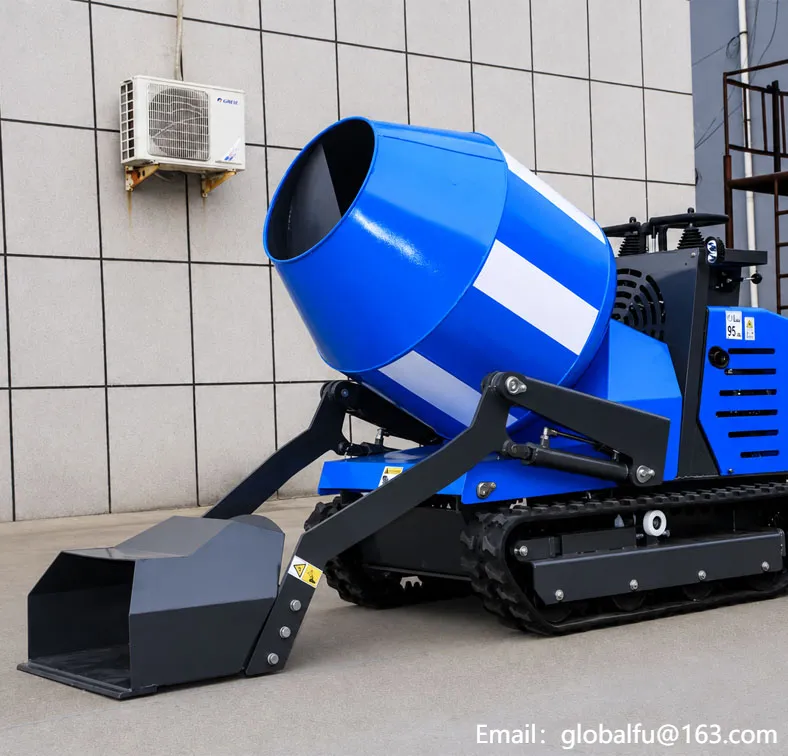
Kaishun’s self-loading mixer range runs from 0.32 to 4.0 CBM output capacity across nine models. For a remote-infrastructure comparison, the 3.5 CBM and 4.0 CBM units are the relevant anchors — large enough to carry meaningful daily output without a plant nearby.
Shared specifications across both models:
- 4×4 drivetrain for unpaved and rough-terrain site access
- 270°/290° drum rotation for controlled discharge into forms or onto a placement point
- Sealed worm-gear rotary table, covered by a 5-year warranty
- Diesel engine, sized to the drum capacity
- ISO 9001 and CE certification (certificate numbers available on request)
The step from 3.5 to 4.0 CBM is a per-cycle output increase, not a change in drivetrain or terrain capability — both units are built on the same 4×4 chassis approach, so the choice between them comes down to how much concrete a single cycle needs to deliver, not which one can reach the site.
Emissions and Import Eligibility
Engine emissions compliance affects whether a self-loading mixer can legally be imported and operated in a given market, separate from the site-access question this comparison is otherwise built around. Non-road diesel machinery is governed by EU Stage V in the EU and US EPA Tier 4 Final in the United States — standards distinct from on-road vehicle emissions rules, which is a common point of confusion when comparing a self-loading mixer’s engine to a transit truck’s engine, since the two are certified under different regulatory frameworks entirely. A contractor bidding work that requires EU or US import should confirm which standard the specific model is certified against before including it in a bid, rather than assuming compliance from the machine’s general specification sheet.
FAQ
Q: Does Kaishun manufacture transit mixer trucks or batching plants?
A: No. Kaishun manufactures self-loading concrete mixers. The transit mixer and batching-plant information in this comparison is provided as general industry context to help evaluate when a self-loading machine is the better fit, not as a Kaishun product offering.
Q: Can a self-loading mixer replace a transit mixer fleet on any job?
A: No. It replaces plant dependency, not volume capacity. On large pours near an existing plant, a transit fleet still outproduces a self-loading unit.
Q: How far from a batching plant does it make sense to switch to a self-loading mixer?
A: There’s no fixed threshold — it depends on plant capacity, road conditions, and pour size. As a directional rule, the farther the plant and the more remote or unpaved the route, the more the flat-cost, no-plant-dependency profile of a self-loading unit favors it over truck cycle time that grows with distance.
Q: Does a self-loading mixer need a separate water source on-site?
A: It carries its own water tank as part of the on-board batching system, which is part of what removes the plant dependency in the first place.
Q: Is batch consistency a real concern with self-loading mixers?
A: It’s a real variable, not a defect — batching accuracy depends on the operator following a consistent loading and weighing sequence. Trained, disciplined operation closes most of the gap with plant-controlled batching.











 August 27, 2026